I recently gave a talk -- partly reading, partly summarizing, and partly promising parts yet unwritten of a paper about Alasdair MacIntyre, Saint Anselm of Canterbury (or Bec, or Aosta, depending on where you're from) and medieval moral theory.
My contention -- a friendly one -- is that MacIntyre's account of what took place in that period we call "medieval" would be considerably improved by incorporation of a fuller picture of Anselm's formation and contributions to an ongoing tradition of moral enquiry. MacIntyre calls this "Augustinian", but it is really much broader -- and older -- than the properly augustinian tradition in philosophy or theology.
I think what I'm trying to fix in this paper is encapsulated in one remark: MacIntyre's account of Anselm is precisely what one might expect from a reading that focuses exclusively upon the Proslogion and upon Thomas Aquinas' references to Anselm's theory of truth. Accordingly, my aim is to show, mainly by way of exposition, that Anselm's contributions lay in moral theory as well -- and to set out his influences upon Aquinas as an interlocutor.
Showing posts with label monasticism. Show all posts
Showing posts with label monasticism. Show all posts
Jul 19, 2013
Talk Radio Interview: Saint Anselm's Argument
Last night, I appeared as a guest on an internet radio talk show -- Theology Matters with the Pellews. Devin Pellew turned out to be an engaging host, quite interested in the topic I had proposed to focus upon: the "single argument" Saint Anselm elaborates in his early work, the Proslogion.
The first hour or so of the show was simply Devin and I, doing some back-and-forth discussion, starting with the more general, and then zeroing in on several key themes having to do with Anselm -- I'll say what those were shortly. Then, we had the call-in segment, and I participated in some very enjoyable conversations with several different callers.
If you'd like to hear the show -- or to download the mp3 of it -- you can access it here. For me, it was an opportunity to explore, in a different medium, some themes I've been thinking about for a long time, and to communicate my own interest in these themes to a broader, less academic audience -- the sorts of people actually, that Anselm himself spent much of his time working with, counseling, and even teaching.
So, what did we range over? A number of topics that I think would make good starting points for future blog posts. To start with, Anselm's "argument" turns out not to be the "ontological argument" (a name he wouldn't recognize, since it appears only from the time of Kant onward), but rather a much broader, deeper, yet more interesting structure that runs through nearly the whole of the Proslogion. This shouldn't be surprising, really, if we look at what Anselm himself tells us the argument is suppose to attempt and attain -- or if we actually read the Monologion, for whose multiple arguments this "single argument" is supposed to substitute.
We also talked about Anselm's own purposes in providing this argument in a written form -- he's not doing Christian apologetics as we often conceive of it, not trying to produce arguments to convince the unbelievers primarily. Rather, he tells us that he felt joy in discovering and exploring the argument, and wanted to share that experience -- or at least its apparatus -- with others. Interestingly, this wasn't how he felt about it at the start or in the middle of his enquiry. Another key theme, which I'll doubtless blog about later this Fall, is how Anselm could think, for a while. . . that the argument might actually be a trick of the Devil.
The first hour or so of the show was simply Devin and I, doing some back-and-forth discussion, starting with the more general, and then zeroing in on several key themes having to do with Anselm -- I'll say what those were shortly. Then, we had the call-in segment, and I participated in some very enjoyable conversations with several different callers.
If you'd like to hear the show -- or to download the mp3 of it -- you can access it here. For me, it was an opportunity to explore, in a different medium, some themes I've been thinking about for a long time, and to communicate my own interest in these themes to a broader, less academic audience -- the sorts of people actually, that Anselm himself spent much of his time working with, counseling, and even teaching.
So, what did we range over? A number of topics that I think would make good starting points for future blog posts. To start with, Anselm's "argument" turns out not to be the "ontological argument" (a name he wouldn't recognize, since it appears only from the time of Kant onward), but rather a much broader, deeper, yet more interesting structure that runs through nearly the whole of the Proslogion. This shouldn't be surprising, really, if we look at what Anselm himself tells us the argument is suppose to attempt and attain -- or if we actually read the Monologion, for whose multiple arguments this "single argument" is supposed to substitute.
We also talked about Anselm's own purposes in providing this argument in a written form -- he's not doing Christian apologetics as we often conceive of it, not trying to produce arguments to convince the unbelievers primarily. Rather, he tells us that he felt joy in discovering and exploring the argument, and wanted to share that experience -- or at least its apparatus -- with others. Interestingly, this wasn't how he felt about it at the start or in the middle of his enquiry. Another key theme, which I'll doubtless blog about later this Fall, is how Anselm could think, for a while. . . that the argument might actually be a trick of the Devil.
Sep 4, 2011
Virtuous Humility . . . and Pride?

What particularly caught my attention in that ISME paper were three things: a goal, a claim, and an omission. One of the stated goals was to provide a naturalized account of pride and humility, one which would presumably draw upon the centuries of hard-earned insights and progressively developed intellectual resources of Christian thought on pride and humility but in such a way as to strip away the specifically Christian elements, arguments, appeals, concepts, so as to leave a residue or precipitate equally acceptable (even embracable, incorporable) to secularists of good faith as to committed Christians. The interesting, and to me startling claim was that we ought not only to think in terms of vicious pride, a vicious counterfeit to humility, and genuine and virtuous humility, but also in terms of virtuous pride as well.
The omission was that. . . . well as it turns out, what counted as stand-ins for the wide scope of Christian thought was . . . you guessed it: Augustine and the later, greater Thomas Aquinas. Now, I would be far from faulting diligent study of, and reliance upon, the thought of these two great Doctors, but when it comes to the matter of humility and the distinctively Christian understanding, it can only help one to read monastic as well as scholastic writers – Thomas, for one drew deeply on the wellsprings of wisdom afforded him by generations of monastic authors.
Aug 21, 2011
Catching Up With Anselm the Christian Philosopher

Rereading and ruminating upon these chapters, mulling through them, actively dialoging with their assertions and arguments -- using them as they were designed, by Anselm's own lights -- got me thinking both about Anselm's moral theory (the broad and multifarious topic about which I'm currently -- with painful, though perhaps not painstaking, slowness -- researching and writing a book) and about the "problem" of Christian philosophy (as it is often put, concealing a tangled an wideranging number of problems, issues, historical phenomena, debates. . . ). I noticed a confluence of these two sets of concerns.
Jun 5, 2011
Anselm's Mountain of Humility

One key thing we know about Anselm (in The Life of St. Anselm
May 29, 2011
The Two Guardians of the Mountain of Humility

The last post in this series, More on Anselm and Humility -- I'm almost embarrassed to admit -- dates back almost one month. Today, in order to get things moving again, I'm just providing long-overdue translation, sans commentary on this extremely interesting set of metaphors. Next week I'll go into the twists and turns of these passages and discuss them in detail. So, here they are: those two previously promised sisters, the guardians of the mountain of humility.
Apr 17, 2011
Saint Anselm on Anger (part 6 and end)

Often, anger also involves a fundamental choice, a willing -- though not necessarily or even often one made deliberately, consciously, with entire awareness -- not to align one's will with God's will, but instead to follow one's own course, one's propria voluntas, to use the human rational will's capacity for self-governance, self-determination in a away that seems in the moment to exercise that capacity to the fullest, but which in reality ends up subjugating that will, that freedom, that instrument of choice to objects or persons outside the will or to a portion -- not the better portions -- of the human being, the carnal appetites and desires which like seeds extrude their tendrils throughout the will, setting down the roots of vices.
Christianity contributes a fuller, though very challenging, perspective upon anger. The task of the Christian moral theologian or philosopher is not only to follow counsels and dictates provided by relevant scriptures, by the example and words of Christ, the saints, even those around one who are better disposed in relation to anger. It is to bring additional illumination to our understanding of this tricky, seductive affective response, one so apt to subvert the very rationality and justice that should in some cases block or censure anger, and in others moderate, rightly direct, or temper it. The Doctor of Bec does make such contributions, and in this final entry on Anselm and anger, we'll look at those that have to do specifically with virtues and vices.
Mar 11, 2011
Reflections on Repentance, Psalms, and Philosophy
Wednesday was one particularly important days of the liturgical year, involving a ritual often viewed as distinctively or exclusively "Catholic," often to the dismay of Protestants belonging to denominations which retained enough from the Catholic church for their more radical Protestant brethren to criticize them as remaining still far too "popeish" -- Lutherans, Anglicans (including Episcopalians), Methodists (who after all were at one time Anglicans themselves). . . really anyone who recognizes some sense or value to a liturgical year might find themselves marked by an ashy cross smudged on their forehead. This includes those Evangelicals who, regretting losses which occurred through ever more radical waves of Reformation, are now finding value in cautiously reappropriating rituals, notions, actions, lines of thought, ways of life formerly considered far too Romish. My partner texted to tell me how startled she was at the sight of a drive-through where one could be marked with the sign of repentance. For me, that is Evangelicals doing things as they tend to do them best, enthusiastically, exploiting aspects we Christians less experimental and settled in our ways of doing things would never think of, sometimes introducing a bit of unintentional comedy.
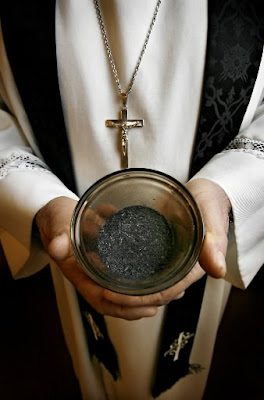 Ash Wednesday introduces the season of repentance -- with prayer, alms-giving, fasting as the traditional pillars. Every religious tradition I have studied -- and I've not only been researching religions since I was a teenager, but had the opportunity to teach a Religious Studies curriculum for 6 years at a former job, so I've covered quite a few -- every religious community has some way of marking time, of structuring the cycles and patterns of life, something akin to a liturgical year, in which narrative intersects with and is enacted within calendar, where feasts or fasts for some at least are prescribed or proscribed, where space and time, and even silence for self-reflection is opened, where the theme of sin, distance from God and from neighbor, from the persons we ought to be (and study of actual world religions, in their practice, in their scriptures, will tell you that the notion of sin is a lot more widespread than some polemically maintain), becomes a focus. Sin is multiform and multifaceted, and may be grasped by numerous holds, some of them intellectual, some of them much more affective, some more global, involving universal experiences and conflicts, others so personal that the one holding them within may doubt whether anyone else has ever felt, suffered, done, and regretted what -- or like -- they have. And all of those complexities and stances, realizations, and progressions and degenerations of moral life are rolled up, implicitly, into the ordering of Ash Wednesday, and Lent, and the Passion, and Easter and . . . .
I pray the Liturgy of the Hours (these days using iBreviary) -- at some times of my life diligently, at others desultorily -- or better put, since I hardly feel as if I'm praying them, I read them, I speak them, or I sing them. This is another one of those complex intersections of text, ritual, daily practice, tradition of whose depths and fertility some Evangelicals, among others, are becoming aware and enamored. The Liturgy consists in arranged prayers, many of them Psalms, read at given points in the day. There is a cycle to it, where canticles and verses, Scripture readings and commentaries (in the Office of Readings) bob and weave, dance and chant their ways in and out of the weeks and months. The Liturgy of the Hours is a complex pattern woven largely out of Scripture, and if one desires or aims to know Scripture better, particularly the Psalms, it is highly recommendable.

I pray the Liturgy of the Hours (these days using iBreviary) -- at some times of my life diligently, at others desultorily -- or better put, since I hardly feel as if I'm praying them, I read them, I speak them, or I sing them. This is another one of those complex intersections of text, ritual, daily practice, tradition of whose depths and fertility some Evangelicals, among others, are becoming aware and enamored. The Liturgy consists in arranged prayers, many of them Psalms, read at given points in the day. There is a cycle to it, where canticles and verses, Scripture readings and commentaries (in the Office of Readings) bob and weave, dance and chant their ways in and out of the weeks and months. The Liturgy of the Hours is a complex pattern woven largely out of Scripture, and if one desires or aims to know Scripture better, particularly the Psalms, it is highly recommendable.
Mar 6, 2011
Saint Anselm on Anger (part 3)
 The last two Sundays, I posted installments of serialized set of posts, part 1 and part 2 of a longer study of how anger fits into Saint Anselm's moral theory. That study in its turn forms part of a broader-scope, ongoing set of examinations of anger (and connected topics) as understood by philosophers, theologians, psychologists, and (perhaps later) literary figures, ultimately intended to be housed in books (one of which, dealing with Aristotle on anger, I'm working on currently). Here, in this format, I work out and provide for interested readership the shorter, more preliminary studies of anger that later find their way into more systematic, academic manuscripts.
The last post on Anselm identified four Anselmian virtues bearing on anger: patience, meekness, humility, and justice, and noted that each of these virtues was a particular habitual and dispositional structure of the human will, instantiated not only in the uses the human person chooses to make of his or her will, but even more so in lasting affective currents of desire, fateful shaping, character, what Anselm calls will as affectio.
In order to better understand virtues, and their opposite, vices, we have to understand the will, and that requires us to understand a number of other interrelated matters. There are good reasons why we human beings are so often mysteries to ourselves even when we think we best understand and know ourselves, and Anselm touches on this while mimetically representing what must have been a common enough occurrence in his life and teaching, begging off from giving his views and rational reflections on a divine mystery in Cur Deus Homo:
we need an analysis of ability and necessity and will and of other notions which are so interrelated that no one of them can be fully examined apart from the others. . . . For an ignorance of these notions produces certain difficulties which become easy to deal with as a result of understanding these notions.
Feb 13, 2011
Anselm's Similitude: The Monk as a Coin

In that text, however, it is "thoughts which arise in our hearts" which are to be tested for their qualities, each examined for its "origin and cause and author." We are to assay the metal, to discern whether it is genuine gold, or just a copper denarius covered over with gold. We are also to determine whether it bears the image of the right king, rather than an usurper. And, we are to test whether it carries the proper heft, or whether it is under weight.
Anselm transposes the metaphor metonymically from the thoughts of the person to the person him or herself, producing a somewhat new similitude. The three qualities of purity, weight, and bearing the proper mark are incorporated, but take on new meanings, which Anselm explores as he works out the analogy. One interesting difference is that in Cassian's trope, the pure coin is a gold one, not the copper denarius, while Anselm's pure coin is precisely that. A later chapter takes up and further develops the coin likeness, and so I include its translation here as well.
De Similitudinibus, Chapter 90. A similitude between a monk and a denarius
Again, we should see from something similar, what should be in a perfect monk. There are three things in any good denarius, that should be in any good monk. For indeed a good denarius should be of pure copper, weigh the right amount, and be marked by a legitimate mint. But if one of these should be lacking, it would not be able to serve as money. For, in order for it to serve as money, it has to have these three things together. Feb 12, 2011
John Cassian on Anger, Revisited

If a person is entirely responsible for their own anger, if seeing things rightly and making progress depends on grasping this very truth that one cannot displace the blame for one's anger onto another, onto the towards whom one feels angry -- doesn't that go for me too? Why isn't my neighbor also entirely responsible for his own anger? Does not his or her responsibility absolve me then of mine? Going further, if there is some responsibility still on my side, well then, what of God, if He made me angry -- or certainly made people angry with Him as recorded in Scripture? Would not that line of reasoning make God also responsible?As typically the case with paradoxes, more resides beneath the surface than appears at first glance. One can twist this plaint in two different directions: a horizontal one, remaining on the same, human level; and, a vertical one, looking upwards, bringing God in for argument. This latter, one should point out, can go two ways as well: one might point to Scripture's instances and examples of divine anger, and ask: look, if it's all right for God to be angry -- and He's God after all -- why not me? Alternately, one might also find fault with the way God has managed matters, the providential ordering by which He arranges the world, one so complex, flexible, and yet inescapable that even human free will is able to be incorporated within it.
Jan 23, 2011
John Cassian on Anger (part 1 of 2)
John Cassian is of the lesser-well-known but historically influential theorists who stakes out an interesting and (to some) attractive position on anger. An important 5th Century monastic Father (particularly in the West), Cassian traveled from his home in the Latin-speaking West to take vows in a monastery at Bethlehem, and then with permission (and accompanied by his fellow monk and childhood friend Germanus) traveled to monasteries in Egypt to study their ways of life through observation and conferences with abbots. Back in the West, settling at Marseilles, he set down the fruits of this experience and his reflections in two works: the systematic Institutions, which sets out the practices, insights, rules of the eastern monks, adapting them to a new European milieu and climate; and the more topically organized (still, in sections fairly systematic) Conferences, reconstructions and recollections of his discussions with the abbots of the East.
 Cassian's works played a very important role in the development of Western monasticism. Since monasteries, institutions oriented by a common and deliberate way of life, were spiritual, cultural, intellectual, and often political centers, the influence of what we might call "Cassian's doctrine" could be more widely extended than just to monks who read him or who heard his books read, e.g. during their common meals (The Rule of Saint Benedict recommends Cassian by name for this).
The centrality of themes of monastic practice and community raises an important issue. Should we assume that the ethical standpoint Cassian reports on and elaborates is one solely for monks? Are his insights only for those on the path of perfection, retired from the world and its cares, closer to God than us laypeople living -- and getting angry -- in the midst of things? He does have several things quite relevant to say bearing on such worries, revealing to us that the human heart, beset by the temptation to and habits of anger remains just as much of a battleground for monks and hermits as it is for clergy and laity.
 Cassian's works played a very important role in the development of Western monasticism. Since monasteries, institutions oriented by a common and deliberate way of life, were spiritual, cultural, intellectual, and often political centers, the influence of what we might call "Cassian's doctrine" could be more widely extended than just to monks who read him or who heard his books read, e.g. during their common meals (The Rule of Saint Benedict recommends Cassian by name for this).
The centrality of themes of monastic practice and community raises an important issue. Should we assume that the ethical standpoint Cassian reports on and elaborates is one solely for monks? Are his insights only for those on the path of perfection, retired from the world and its cares, closer to God than us laypeople living -- and getting angry -- in the midst of things? He does have several things quite relevant to say bearing on such worries, revealing to us that the human heart, beset by the temptation to and habits of anger remains just as much of a battleground for monks and hermits as it is for clergy and laity.
Subscribe to:
Posts (Atom)