Showing posts with label medieval theology and philosophy. Show all posts

May 6, 2020

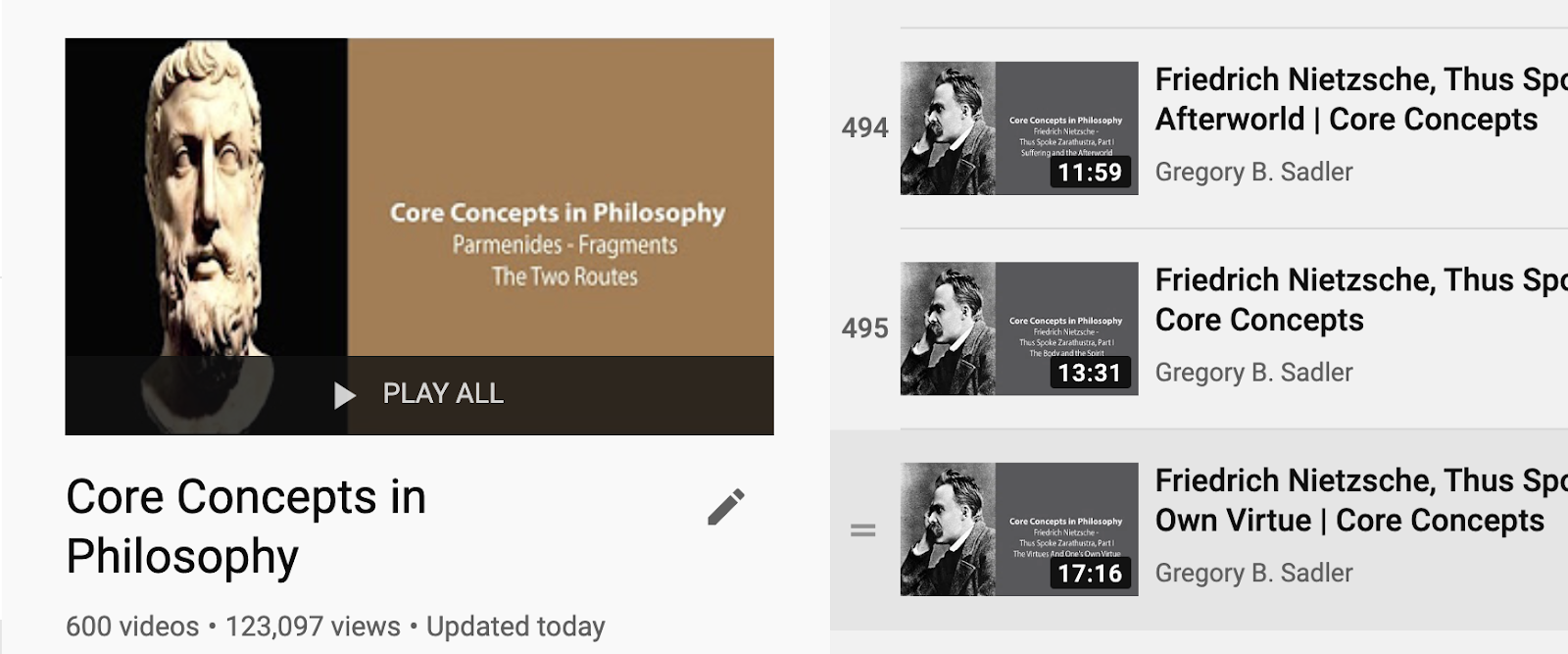
Core Concept Playlist Split into Five Playlists


For years, I have been producing shorter (10-25 minute) videos on key ideas, distinctions, arguments, and topics in philosophy.  I use these routinely as a resource for my students in classes that I teach. 

Many other people use them as well.  Students in other people's classes watch or listen to them to help them understand their assigned material.  Lifelong learners use them to study or just brush up on philosophy.  Professors sometimes assign them to their own students, and I've even had some instructors write to tell me that the videos helped them prepare their own class notes, lectures, and discussions!

I used a YouTube playlist to gather them all together into one place, and that worked all right for a while.  But some time back, I passed the 600-video mark in that playlist, and it began to develop some glitches (which is actually not bad, since YouTub officially says don't put more than 200 videos in a playlist!), so I've been kicking around the idea of splitting the one massive playlist into five more manageable ones.

What kept me from doing that for the time being was the work involved.  It means going in manually and moving all of those videos around.  So I've been putting it off for quite a while.  But today, I bit the bullet, put in the hours of work, and now all five are ready for prime time (or whatever the equivalent is for YouTube!).  With no further ado, here they are (click on the link to see the actual) playlists).

  • Ancient Philosophy - 340 videos on Parmenides, Zeno of Elea, Plato, Aristotle, Epicurus, Cicero, Seneca, and Epictetus
  • Medieval Philosophy and Theology - 64 videos on Augustine of Hippo, Anselm of Canterbury, and Thomas Aquinas
  • Modern Philosophy - 80 videos on Rene Descartes, Blaise Pascal, David Hume, Jeremy Bentham, and Immanuel Kant
  • 19th Century Philosophy and Literature - 70 videos on G.W.F. Hegel, Soren Kierkegaard, John Stuart Mill, Leo Tolstoy, Fyodor Dostoevsky, Friedrich Nietzsche, and William James
  • 20th Century Philosophy and Literature - 127 videos on A.J. Ayer, Martin Heidegger, Rainer Maria Rilke, W.D. Ross, Gabriel Marcel, Jean-Paul Sartre, Simone de Beauvoir, Albert Camus, Ruth Benedict, Hannah Arendt, Ayn Rand, John Rawls, George Dickie, Ursula K. Leguin, Lawrence Kohlberg, Virginia Held, Alasdair MacIntyre, Mary Midgley, James Rachels, Rosemarie Tong, and Peter Singer

That's 681 total core concept videos - quite a lot!  As I look at it, I'm pretty sure that I'll need to split that first playlist again sooner or later (most likely into everything before and including Aristotle, and everything after him).

So if you're looking for short, on-point, accessible but rigorous videos on any of these thinkers, you can now much more easily find them.  Just click on the relevant playlist and you'll be able to see everything I've got available in that format.

Nov 19, 2019

Philosophers in the Midst of History Year 5 Scheduled!


Earlier this month, we had the final session for this year in the Philosophers In The Midst of History public talk series, discussing the 20th century existentialist and feminist thinker, Simone de Beauvoir (watch the videorecording here).  She is probably best known for her work The Second Sex, but we also devoted some discussion to another important book of hers, The Ethics of Ambiguity.

That session was number 16, which brings a close to the fourth year of this quarterly series.  We already have a fifth year scheduled, hosted again at the Frank Weyenberg Library (located in Mequon, Wisconsin), and we'll be doing a bit more public promotion of these events in the year to come.

I imagine that my readers are probably more interested in what thinkers we'll be covering next year than in the details about planning and public outreach, and I'm happy to be able to announce them.

For the Ancient period, we'll be focusing on Epicurus.  We've already discussed Plato, Aristotle, Cicero, and the Stoic philosopher Epicteus, so it's about time we bring in some discussion of the founder of this major philosophical school of antiquity.

For the Medieval period, I decided that it would be interesting to discuss a rather controversial figure.  I don't mean Abelard, Scotus, or Ockam (I did consider doing Abelard and Heloise) - but rather the 13th-14th century German Dominican philosopher and mystic, Meister Eckhart.  That focus will provide a nice supplement to the talks already given on Augusting, Boethius, Anselm on Canterbury, and Thomas Aquinas.

For the Modern period, we'll be looking at the all-too-often neglected philosopher Mary Wollstonecraft.  She's someone I teach frequently and occasionally give talks on, and I'm hoping that preparing this lecture might also provide me with the needed impetus to get some papers on her I've been working on for several years brought to fruition and sent out for publication.  We've previously focused on Thomas Hobbes, Rene Descartes, John Lock, and Jean-Jacques Rousseau in that time-period.

We end each year with a philosopher from the 19th or 20th century, and this time I thought I'd give it a bit of a twist, discussing someone who clearly is a philosopher, but whose works tend to be read more outside of that discipline, the great French writer, Alexis de Tocqueville, who, among other things authored works exploring the French Revolution, the American prison system, and the nature of American democracy by contrast to European democracy.  This will add him to the four thinkers from that period we've already covered, namely Friedrich Nietzsche, Albert Camus, Hannah Arendt, and Simone de Beauvoir.

If you'd like to watch or listen to any of the previous 16 sessions - they're roughly 75-90 minutes or so in length - here's the YouTube playlist of the series.

If you're in the area, and you'd like to attend, you might want to mark your calendar - the talks will be coming up at 6 PM on February 5, May 6, August 5, and November 4, hosted at the Frank Weyenberg Library.

Nov 10, 2019

The Core Concept Playlist Reaches 600!


Earlier this year, we hit a milestone for one of my video series.  The Core Concept playlist reached the 500 video mark back in March, and we celebrated with an online party, hosted on YouTube Live. We've now reached another milestone - though I don't plan to do another party for a while - with the public post of video #600 in the series

I first started creating these shorter, more single-issue focused videos as learning resources for students enrolled in my face-to-face classes (at that time at Marist College).  It didn't take long before I realized two things.  First, they could be even more useful for the online classes I was beginning to teach and to develop.  Second - as was the case with my other videos - students, lifelong learners, and even other instructors all across the world were watching the new videos and using them as resources.

My selection of what texts and thinkers to focus upon for the core concept videos has been driven primarily by the needs of my classes.  Each semester I try to add some new content, and - provided I actually have the time - I'll create new videos on that new material.  Sometimes that leads to a lot of videos, enough to cover entire works like Aristotle's Nicomachean Ethics, Rene Descartes' Meditations, or Immanuel Kant's Groundwork for the Metaphysics of Morals

Every once in a while, if I have enough time on my hands, I'll shoot a sequence of core concept videos on a thinker whose work deserves the in-depth video treatment, but which I don't have any immediate plans to teach.  So for example, some time back I shot an entire sequence on Aristotle's short work, the Categories.  Last Fall, I created a few videos on Pascal's Pensees.

At this point in time, here are the thinkers on whom I've got at least one core concept video available:

  • Ancient Philosophy:  Parmenides, Zeno of Elea, Plato, Aristotle, Epicurus, Cicero, Seneca, Epictetus
  • Medieval Philosophy: Augustine, Anselm of Canterbury, Thomas Aquinas/
  • Modern Philosophy: Rene Descartes, Blaise Pascal, David Hume, Jeremy Bentham, Immanuel Kant
  • 19th Century Philosophy: G.W.F. Hegel, Soren Kierkegaard, John Stuart Mill, Friedrich Nietzsche, Fyodor Dostoevsky
  • Early 20th Century Philosophy: Martin Heidegger, Rainer Maria Rilke, Gabriel Marcel, Jean-Paul Sartre, Simone de Beauvoir, Albert Camus, W.D. Ross
  • Later 20th Century Philosophy: Ayn Rand, Ruth Benedict, Alasdair MacIntyre, Lawrence Kohlberg, Virginia Held, James Rachels, and Rosemarie Tong
If you'd like to look around through the Core Concept Videos playlist, click here, and you'll have access to those 600 free videos!

Nov 5, 2019

Session #16 in Philosophers in the Midst of History Tomorrow!


After we moved back here to Milwaukee, we partnered with several area libraries to provide talk series connected with philosophy.  We're now nearing the end of year 4 in two of those series.  One of them is the monthly Worlds of Speculative Fiction, hosted at the Brookfield Library.  The other is the quarterly Philosophers in the Midst of History, hosted at the Frank Weyenberg Library in Mequon.

In that second series, I discuss an ancient philosopher in the Spring, a medieval philosopher in Summer, an early modern philosopher in Fall, and a late modern philosopher in Winter.  This year, we finish up the year with a talk focused on the French existentialist and feminist author, Simone de Beauvoir.  So if you're in the Greater Milwaukee area, free around 6 PM, and looking for a stimulating discussion, you might want to drop in!

We videorecord all of the talks in the series, so if you've missed the other sessions, and would like to learn about these philosophers, their historical context and background, and how they contributed to history themselves, here are those 15 videos:

Oct 20, 2019

Six Videos on Augustine of Hippo's On Free Choice of the Will, book 1


I've been teaching Augustine's On Free Choice of the Will in my Introduction to Philosophy and Foundations of Philosophy classes for a number of years.  In the past, I have had students read the entire work, but given how many other texts I usually pack into a semester, I've trimmed down our study to just book 1 of the work.

Creating video content - as busy as I am - is a continual process, and I'm not always able to shoot video on all of the texts I teach in face-to-face classes.  I was able to produce core concept videos on portions of a different work by Augustine in the past - his City of God - but I didn't manage to get to On Free Choice of the Will until this term.

Now, I have six videos on key topics in book 1 of that work available for not only my students, but also for the general public.  Here they are:

Oct 9, 2019

Five Videos on Thomas Aquinas on Happiness


I created another set of short lecture videos for my students, enrolled in my Introduction to Philosophy and my Foundations in Philosophy classes, focused on a key discussion by Thomas Aquinas in question 2 of the First Part of the Second Part of his Summa Theologiae.  It is often called the "treatise on happiness", and that is the focus of those discussions.  What is the nature of human happiness?  What - among the things that people think will make them happy - really does make human beings happy? 

Here are those five videos, which I released early to my Patreon supporters last month:

Sep 14, 2019

Seven Videos on Anselm's On Freedom of Choice


One of the texts I've been teaching for a number of years in my classes is Anselm of Canterbury's On Freedom of Choice.  It's a short dialogue between a teacher and a student, with the teacher clearly as a stand-in for Anselm.  On Freedom of Choice is the second dialogue in a trilogy of works, intended originally to aid the monks under his charge with their study of Scripture.

The other two works in that trilogy are also dialogues, the first one being On Truth, and the third, the significantly longer On The Fall of the Devil.  If you're interested,  you can get all three in a single affordable volume, ably translated by Thomas Williams and published by Hackett.

Anselm summarizes what On Freedom Of Choice is about in the preface to the three dialogues:
[W]hat freedom of choice is, whether a person always has it, and how many distinctions of freedom there are with respect to having or not having uprightnessof-will. . .  In this treatise I show only the natural strength of the will for keeping the uprightness which it has received; I do not show how in order to keep uprightness the will needs the accompaniment of grace.
This summer, knowing I'd be teaching the text again, I decided it was about time to create some core concept videos as aids for my students.  Here are those seven videos:

Mar 10, 2019

A Milestone - 500 Core Concept Videos!


Years back, I started producing a new kind of video, in a series I called Philosophy Core Concepts.  After seeing the hour-long videos I recorded in my Critical Thinking, Introduction to Philosophy, and Ethics classes take off, I started thinking about other sorts of videos I might produce that would be useful for my students and for other viewers worldwide.

There were already quite a few short (anywhere from 2-10 minutes), often quite high-production videos on topics and thinkers in philosophy.  But in my view, they were pretty hit and miss.  Some of them could be quite good.  Many of them were actually poorly informed, misleading, or biased.  And then, there were a lot in between.  That's not surprising.  Two things are needed to successfully teach about philosophy in videos.  You've got to really know what you're talking about.  And you've got to give people enough actual content - which then requires a longer amount of time.

I decided to stick with my low-tech, minimally produced approach - if the content is actually engaging, even without animations, sound effects, and the like, people will want to watch it - and started creating these new Core Concept videos.  They range between 10-30 minutes in length.  In format, it's just me in front of the chalkboard, presenting one key idea, distinction, argument, account or other bit of philosophy, from some important thinker.

You can see the entire playlist by clicking here.  Scroll down and you'll find a number of videos on a variety of philosophers from Ancient, Medieval, Early Modern, 19th Century, and 20th Century philosophy.  So far, I've created videos on Plato, Aristotle, Epicurus, Cicero, Seneca, Epictetus, Augustine, Anselm, Thomas Aquinas, Rene Descartes, Blaise Pascal, Jeremy Bentham, Immanuel Kant, G.W.F. Hegel, Soren Kierkegaard, John Stuart Mill, Friedrich Nietzsche, Martin Heidegger, Jean-Paul Sartre, Albert Camus, W.D. Ross, Ayn Rand, Alasdair MacIntyre, Viriginia Held, James Rachels, and Rosemarie Tong.

Over the years, I have invested in better lighting, a voice recorder, and a superior camera, but I've kept the approach consistent.  Short videos with me lecturing engagingly in front of a chalkboard with notes on it.  I plan to keep on shooting these - they're a valuable resource for the classes I teach, and other people find them useful as well - expanding the series well past the 1,000 video mark.  There are quite literally hundreds of texts and dozens of additional thinkers I'd like to cover.

A bit later today, I'll be hosting a YouTube Live session to celebrate this milestone with my viewers, fans, and subscribers.  If you'd like to join in on that - and get to vote about the area you'd most like to see me focused on for videos in the near future - you can click here to find out more (and set up a reminder for yourself). 

On a final note, if you'd like to support my ongoing work in producing these valuable educational resources, there's two ways you can do that.  To become a monthly supporter, click here to go to my Patreon page.  If you'd like to make a one-time donation, you can do that here through Paypal.

Feb 14, 2019

Five Videos on Anselm's Proslogion

As I've mentioned in earlier posts, I have been creating new core concept videos for students enrolled in my college classes this semester.  So far I've released several new series, links to which are below.

One of the texts we are covering in its entirety in my Marquette classes, and just in part in my MATC class, is Anselm of Canterbury's short work, the Proslogion.  I created five new core concept videos covering some of the main aspects and arguments in that work (which is, according to Anselm, one long single "argument").  I hope to get to some additional videos on this work later on down the line, covering some of the other issues examined in the text.

Anselm is relatively poorly know and not all that often read (if you like, you can read my IEP article on Anselm).  When he does get addressed by philosophers, it is usually the Proslogion to which they turn, and typically just chapter 2 (and sometimes 3 and 4), where Anselm sets out what has come to be called the "ontological argument for God's existence".  There's far more going on in that book, however, as you'll see if you read it, or even if you watch the videos below.

So here they are:

In the last few months, I have also created several other series of core concept videos, on other key philosophical texts.  You might find these interesting or helpful:

I'm in process of shooting a lot more video content, and you'll see more posts like these in the coming months.  We've got more Cicero coming up, as well as more Augustine, Anselm, Thomas Aquinas, Rene Descartes, David Hume, Hannah Arendt, James Rachels, and Lawrence Kohlberg, to name a few.

If you'd like to support the work I do, creating these videos in my home studio, used by learners worldwide, consider becoming a Patreon supporter!

Jan 6, 2019

Ten Videos on Augustine's City of God

Last semester, I started shooting a set of short lecture videos on the early Christian philosopher, Augustine of Hippo's City of God as resources for my students in two of my classes.  That late work of Augustine is a pretty massive tome, so we were just covering a selection of topics in books 5, 11, and 19 of the text.

The topics that we examined - human free will and divine foreknowledge, the role of Christian revelation in philosophy, created time and space, what human happiness requires, the virtues in their struggles with vices, and the extent of community - are all important in Augustine's thought as a whole.

The semester got away from me - I ended up taking on five classes (more than full time for academic teaching) - so I wasn't able to get to all of them until later on in December, after classes ended.  Here is the full set on the City of God - to which I will perhaps add additional videos down the line.
This semester, I'll only be teaching some of this material from book 11 of City of God in my classes.  But I will be covering a different Augustine text, his earlier work On Free Choice of the Will.  I'll be creating new core concept videos on that book later on in the semester.

Dec 18, 2016

Philosophy As A Way Of Life - Who Else Besides Hadot?

One of the areas I work in as a professional philosopher is Stoic philosophy. Up to this point, I've admittedly published relatively little in traditional academic formats about Stoicism, but I regularly write, speak, and produce content about Stoicism in more popular and public settings.  Currently, I also edit an important forum for modern interpretations, discussion, and application of Stoic philosophy, Stoicism Today.  Though I'm not an orthodox Stoic, but rather an avowed eclectic, I draw upon and apply Stoic insights, practices, and techniques, not only in my own life, but also with clients in my philosophical counseling practice.

As a result, I move in quite a few circles that consist of other people who are interested in Stoicism.  That's actually something I'm very happy and grateful about - that I get to engage in conversations, not just with fellow academics, but with all sorts of people about philosophy.  Sometimes this takes place at an introductory level, but often the people I get into discussions with have developed an admirably extensive grasp of Stoic literature and doctrine.  The people drawn to Stoicism very often are interested in applying it - it putting it to work, and thereby also putting it to the test.  That is because, to use the phrase the Pierre Hadot so famously popularized, Stoicism is the sort of theory or doctrine that we can call "philosophy as a way of life."

I get asked about Hadot - and about this conception of "philosophy as a way of life" - a lot.  And I have to admit that, at times, I can be a bit brusque or dismissive in my replies, particularly when the assumption seems to be that this realization (that philosophy is meant to be lived and practiced) is something radically new, that until Hadot (or even better, Foucault) came along to reveal this feature of ancient philosophy to us, we late modern philosophers were all in the dark about this.  So here, I'd like to provide a reply at length to an interlocutor who was asking me about that topic - "philosophy as a way of life".

Jun 10, 2016

Free Video Resources on St. Anselm's Monologion

Off and on, from March to May, I created a new series of Core Concept videos devoted to a classic text of Medieval Christian philosophy, Saint Anselm's early work, the Monologion.

This book is in, in fact, Anselm's earliest treatise, written when he was prior of the monastery at Bec, after numerous requests by his fellow monks that he write down some of the arguments, reflections, and explanations about the divine substance that he was providing them with in his teaching and conversations.

I shot and uploaded this sequence of videos, covering most of the chapters and topics in the Monologion.  For whoever would like to watch and use them, here they are - all 24 of them.


I'll be producing further videos on Anselm later on this Fall, starting with his next main work, the Proslogion. If you're interested in further study of Anselm's texts with me specifically, I will be teaching an online course on Anselm later on this Fall, and I'm always available for tutorial sessions

Sep 16, 2015

Understanding Anger - Lecture 9: Thomas Aquinas On Anger

Our series of monthly lectures for this year -- hosted by the historic Kingston Library -- has come to a close, with a well-attended and very enjoyable last session.  The topic for this talk, Thomas Aquinas' perspective upon anger, tied together thematic threads from many of the previous sessions, particularly because Thomas himself was a great systematizer and synthesizer of previous points of view.

In the previous session, we examined several early Christian thinkers who discussed anger (you can watch the video of that earlier session here), taking us up to the 5th century AD, the cusp between antiquity and the middle ages.  In this final session, we focused on a thinker solidly in the midst of the medieval period, the 13th century, often called the "high middle ages."  You can watch the video of that very lively discussion here.

Apr 7, 2015

Anselm on Divine Power and Greatness


Recently, the web-comic xkcd put out a one-panel one-liner that caught my immediate attention as a sometime scholar working on Anselm of Canterbury.  He's often credited with originating the "ontological argument," in some important senses a misattribution, since that term comes into use much later, in the 18th century, and since Anselm's "unum argumentum" is actually nearly the whole of the Proslogion, not just the second chapter -- there's even more to be said, but those are topics for another day, and a different post.

What's particularly interesting to me about this is the question that's being asked in the panel -- not the part about a "flaw" in the ontological argument, but rather the much more intriguing question hinted at about divine power, or rather omnipotence, and its intersection with the "that than which nothing greater can be thought" reasoning driving Anselm's argumentation in the Proslogion.  Here's why that issue is well worth thinking through in light of Anselm's actual texts and thought:

Nov 17, 2014

A New Class: Philosophical World Views and Values

This marks my fourth year teaching classes in Philosophy and Religious Studies for Marist College.  The last three years have involved a mix of face-to-face and online classes -- this current academic year, however, I decided to switch entirely to teaching online for Marist.  There's a whole story behind that decision, which perhaps I'll tell in a later post -- suffice it to say that one of the main reasons was to afford me greater flexibility and more time to devote to doing more innovative work in Philosophy -- bringing it into practice, and putting it before a broader public.

In early December, I start teaching a new 10-week online course -- World Views and Values.  It's essentially a variation on Intro to Philosophy, but it's one which transfer students have traditionally taken in place of Intro (which has since been renamed "Philosophical Perspectives"!), and it bears a different course description: 
This course will help students to ask basic questions about the ultimate meaning of life, to take a comprehensive and holistic world view, and to articulate a coherent values system. The basic methodology for teaching the course is comparative and socioanalytic. 
So really, a lot of leeway there for doing what one would like with the course.  I decided to put a lot of thought into designing precisely the sort of course I think might be most useful and interesting for the students -- and enjoyable for me to put together and teach.

Jul 31, 2013

Inserting Anselm into Alasdair MacIntyre's Narrative of Medieval Thought

I recently gave a talk -- partly reading, partly summarizing, and partly promising parts yet unwritten of a paper about Alasdair MacIntyre, Saint Anselm of Canterbury (or Bec, or Aosta, depending on where you're from) and medieval moral theory.


My contention -- a friendly one -- is that MacIntyre's account of what took place in that period we call "medieval" would be considerably improved by incorporation of a fuller picture of Anselm's formation and contributions to an ongoing tradition of moral enquiry.  MacIntyre calls this "Augustinian", but it is really much broader -- and older -- than the properly augustinian tradition in philosophy or theology.

I think what I'm trying to fix in this paper is encapsulated in one remark:  MacIntyre's account of Anselm is precisely what one might expect from a reading that focuses exclusively upon the Proslogion and upon Thomas Aquinas' references to Anselm's theory of truth.  Accordingly, my aim is to show, mainly by way of exposition, that Anselm's contributions lay in moral theory as well -- and to set out his influences upon Aquinas as an interlocutor.

May 4, 2013

Another Anselm Lecture

I'm finally getting around to posting this here in Orexis Dianoētikē -- I can plausibly plead as an excuse  the pressures imposed by (attempting) solid work in my ongoing classes -- a recent lecture I've given on Saint Anselm of Canterbury. 

This particular talk, with some very lively Q & A at the end, comes from the recent conference focused on the question "Must Morality Be Grounded Upon God," hosted by the Franciscan University of Steubenville (incidentally -- and this is entirely off topic -- incorporating the name of one of my long-time heroes, the Baron Von Steuben, drillmaster to the budding Continental Army during our American Revolution).


In this talk, I answer the question structuring the conference with some typically Anselmian, "let's make some distinctions. . .  and then Yes. . .  and No" -- but more Yes than No in Anselm's case.

I'm not entirely happy with the shape of the paper, some I'm loath to upload it into my usual channels like Academia.edu or GoogleDrive -- once I've reworked it, added all the references it need, and I'm satisfied with it, I'll definitely post a copy for public viewing.

There's a reason I rather tongue-in-cheek call this post "another Anselm lecture" -- I've given quite a few of them over the last five years.  Here's a representative sampling:
All of these are supposed in one way or another to feed into the book project I started years back, specifically devoted to systematically reconstructing and setting out Anselm's moral theory.  Although I've written several chapters, work on that particular project moves slower than I'd like.  But, that -- as well as additional work on translating the De Similitudinibus and the Dicta Anselmi -- are matters to which I plan to give much attention this coming summer and fall.

Jun 5, 2011

Anselm's Mountain of Humility

So far, in the Sunday series I've been writing, addressing monastic authors' interpretations of the virtue of humility and its developmental levels, I have discussed -- and in some of the entries, translated (here and here) -- the thought of a later monastic author, St. Anselm. His own reflections and chosen metaphors bearing upon the capital vice of pride and its remedy, the virtue of humility, were no doubt formed through reading, and long meditation placing him in conversation not only with the authors of Scripture but also earlier Christian authors, particularly St. Benedict, St. Gregory, St. Augustine, and John Cassian.

One key thing we know about Anselm (in The Life of St. Anselm) noted by his biographer, Eadmer, a fellow Benedictine monk of Canterbury and a close friend of Anselm's, is that -- although he was certainly not lukewarm about this early on in his monastic profession -- at one point he decisively "gave himself up entirely to being a true monk and to understanding the rational basis of monastic life, and expounding it to others." Before going back to touch base with the last three posts on Anselm and humility, as well as addressing a reader's question whose brevity belies its great usefulness, there are three things I'd like to quickly point out about the perhaps not-so-aptly-named Scholastic Doctor and his works -- some of which are worthy of their own blog posts later, when I have more time.


May 10, 2011

Where I've Been and Where I'm Going

It has been slightly over a week since I posted my last blog entry, which tantalized by promising further translations of Saint Anselm's writings and sayings about humility. I'm thankful that, over the eight months of its publication so far, Orexis Dianoētikē has developed -- for an academic blog written part time by a scholar admittedly and indulgently ranging all over the map of topics -- a solid readership. Doubtless a portion of the numerous reads of the posts and glances over the pages were one-time, non-repeat clicks. A core of devoted readers -- who subscribe, comment, wait for announcements of new posts (on Facebook, Twitter, Academia, and LinkedIn), and praise, condemn, argue or ask questions about the posts in those electronic forums -- has also developed, and continues to grow. Interestingly, a good portion of that readership is international -- particularly from The UK, Canada, Japan, Russia, Germany, South Korea, Brazil, Spain, and China.

I feel as if I owe some explanation to my readers as to why my posts have slowed over the last weeks and perhaps may not resume their normal rate for a little while longer. I am right in the middle of the process of leaving my post at Fayetteville State University, where for the last three years I have taught, researched, started a new projects, and even taken on some administrative, advisory, and assessment positions. Not only am I step by step extricating myself from the University -- grades are in, but I still have four reports to write, and was being called upon to provide information in meetings yesterday and just a few minutes ago (I'm writing this during my last meeting) -- and not only have I been continuing or making good on a number of scholarly projects and commitments -- even more importantly, I am finally moving up to the Hudson valley in New York to end the painfully-long-distance phase of the relationship with my wife-to-be, partner, and collaborator in work, writing, and life. I am very excited to be leaving with my wagon packed to the gills with the first load later on today.

Apr 24, 2011

Anselm on the Seven Levels of Humility

Having finished the six-entry series on Anselm's views on anger, I've decided on a new Sunday blogging project for the time being, one which still focuses on the (somewhat inaptly epitheted) Scholastic Doctor, but now on a different aspect of his moral theory:  the virtue of humility, so central to his life, practice, thought, and counsels -- so difficult and trying a virtue to cultivate (I'll admit, in my experience and after very limited success).  Humility, Anselm says, is needed in order to prepare the ground for, and to stabilize the other moral virtues. 

Unlike anger, Anselm did devote some thematic discussion to humility as such, particularly through a metaphor he develops in considerable depth -- that of a mountain with levels.  Each level corresponds to one degree of humility, a new qualitative addition or deepening of that virtue, in practice, in action.  In the weeks to come, I'm going to compare Anselm's treatment, and the successive levels he outlines, with those of other Christian thinkers who also discussed humility, and similarly distinguished successive degrees, steps, or levels, of that virtue.  One of these at least Anselm knew with an intimacy than which a greater can barely be conceived, for St. Benedict, the founder of the very order in which Anselm lived out nearly all of his adult life, distinguishes and briefly discusses twelve steps or levels of humility.