As always, there's many more people interested than can attend -- sometimes a factor of time, but most often of place -- so we video-recorded the session (you can watch the video here). And as usual, although I came armed with many notes and a few handouts to structure the session, a number of digressions -- all quite interesting -- added some other elements to the discussions.
a locus for updates, events, short reflections, and musings about philosophy, politics, religion, language, and whatever else I decide to post
Showing posts with label wisdom literature. Show all posts
Feb 20, 2015
Understanding Anger - Lecture 2: Jewish Scriptures
As always, there's many more people interested than can attend -- sometimes a factor of time, but most often of place -- so we video-recorded the session (you can watch the video here). And as usual, although I came armed with many notes and a few handouts to structure the session, a number of digressions -- all quite interesting -- added some other elements to the discussions.
Aug 15, 2011
Summer and Winter Foolishness
Years ago in reading, I encountered the distinction between two families of fools -- and two types of foolishness. I've invoked that easily remembered and vivid distinction by way of explanation in many conversations down the years, and have puzzled about precisely what goes wrong with the winter fool -- how to explain their folly in terms of defective practical reasoning, what specific defects or failures are involved, what concepts and what moral theories best illuminate this all-too-common but somewhat complex mode of misreasoning.
Why would this distinction -- originating in a Jewish proverb, then trickling through Russian folklore, eventually popping up and popularized in Hemmingway's For Whom The Bell Tolls -- continue to draw the interest of a moral theorist? Well, for one because folly is the classical opposite to wisdom. It is practical wisdom, what the Greeks called phronesis, what the biblical Wisdom literature (which bears similarities to, draws upon, and reworks other similarly sapiential literature not only names but personifies, what the Latin west in its turn termed at some times prudentia, at others sapientia. It's not enough to know what comprises and constitutes wisdom, though -- and that's tough-enough knowledge to acquire and retain, a never-ending arduous task in actuality -- one also needs to know what the various pitfalls, temptations, and forms of foolishness are, not least to recognize and avoid them, but also to understand them -- for by understanding how one goes wrong, one better grasps how one, choosing differently, goes right.
Mar 11, 2011
Reflections on Repentance, Psalms, and Philosophy
Wednesday was one particularly important days of the liturgical year, involving a ritual often viewed as distinctively or exclusively "Catholic," often to the dismay of Protestants belonging to denominations which retained enough from the Catholic church for their more radical Protestant brethren to criticize them as remaining still far too "popeish" -- Lutherans, Anglicans (including Episcopalians), Methodists (who after all were at one time Anglicans themselves). . . really anyone who recognizes some sense or value to a liturgical year might find themselves marked by an ashy cross smudged on their forehead. This includes those Evangelicals who, regretting losses which occurred through ever more radical waves of Reformation, are now finding value in cautiously reappropriating rituals, notions, actions, lines of thought, ways of life formerly considered far too Romish. My partner texted to tell me how startled she was at the sight of a drive-through where one could be marked with the sign of repentance. For me, that is Evangelicals doing things as they tend to do them best, enthusiastically, exploiting aspects we Christians less experimental and settled in our ways of doing things would never think of, sometimes introducing a bit of unintentional comedy.
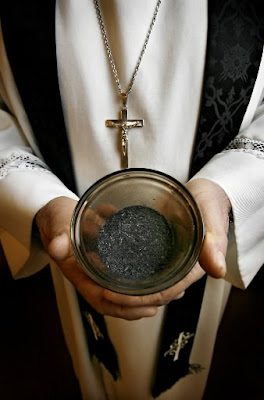
Ash Wednesday introduces the season of repentance -- with prayer, alms-giving, fasting as the traditional pillars. Every religious tradition I have studied -- and I've not only been researching religions since I was a teenager, but had the opportunity to teach a Religious Studies curriculum for 6 years at a former job, so I've covered quite a few -- every religious community has some way of marking time, of structuring the cycles and patterns of life, something akin to a liturgical year, in which narrative intersects with and is enacted within calendar, where feasts or fasts for some at least are prescribed or proscribed, where space and time, and even silence for self-reflection is opened, where the theme of sin, distance from God and from neighbor, from the persons we ought to be (and study of actual world religions, in their practice, in their scriptures, will tell you that the notion of sin is a lot more widespread than some polemically maintain), becomes a focus. Sin is multiform and multifaceted, and may be grasped by numerous holds, some of them intellectual, some of them much more affective, some more global, involving universal experiences and conflicts, others so personal that the one holding them within may doubt whether anyone else has ever felt, suffered, done, and regretted what -- or like -- they have. And all of those complexities and stances, realizations, and progressions and degenerations of moral life are rolled up, implicitly, into the ordering of Ash Wednesday, and Lent, and the Passion, and Easter and . . . .
I pray the Liturgy of the Hours (these days using iBreviary) -- at some times of my life diligently, at others desultorily -- or better put, since I hardly feel as if I'm praying them, I read them, I speak them, or I sing them. This is another one of those complex intersections of text, ritual, daily practice, tradition of whose depths and fertility some Evangelicals, among others, are becoming aware and enamored. The Liturgy consists in arranged prayers, many of them Psalms, read at given points in the day. There is a cycle to it, where canticles and verses, Scripture readings and commentaries (in the Office of Readings) bob and weave, dance and chant their ways in and out of the weeks and months. The Liturgy of the Hours is a complex pattern woven largely out of Scripture, and if one desires or aims to know Scripture better, particularly the Psalms, it is highly recommendable.
Ash Wednesday introduces the season of repentance -- with prayer, alms-giving, fasting as the traditional pillars. Every religious tradition I have studied -- and I've not only been researching religions since I was a teenager, but had the opportunity to teach a Religious Studies curriculum for 6 years at a former job, so I've covered quite a few -- every religious community has some way of marking time, of structuring the cycles and patterns of life, something akin to a liturgical year, in which narrative intersects with and is enacted within calendar, where feasts or fasts for some at least are prescribed or proscribed, where space and time, and even silence for self-reflection is opened, where the theme of sin, distance from God and from neighbor, from the persons we ought to be (and study of actual world religions, in their practice, in their scriptures, will tell you that the notion of sin is a lot more widespread than some polemically maintain), becomes a focus. Sin is multiform and multifaceted, and may be grasped by numerous holds, some of them intellectual, some of them much more affective, some more global, involving universal experiences and conflicts, others so personal that the one holding them within may doubt whether anyone else has ever felt, suffered, done, and regretted what -- or like -- they have. And all of those complexities and stances, realizations, and progressions and degenerations of moral life are rolled up, implicitly, into the ordering of Ash Wednesday, and Lent, and the Passion, and Easter and . . . .
I pray the Liturgy of the Hours (these days using iBreviary) -- at some times of my life diligently, at others desultorily -- or better put, since I hardly feel as if I'm praying them, I read them, I speak them, or I sing them. This is another one of those complex intersections of text, ritual, daily practice, tradition of whose depths and fertility some Evangelicals, among others, are becoming aware and enamored. The Liturgy consists in arranged prayers, many of them Psalms, read at given points in the day. There is a cycle to it, where canticles and verses, Scripture readings and commentaries (in the Office of Readings) bob and weave, dance and chant their ways in and out of the weeks and months. The Liturgy of the Hours is a complex pattern woven largely out of Scripture, and if one desires or aims to know Scripture better, particularly the Psalms, it is highly recommendable.
Dec 5, 2010
Wisdom Literature and Philosophy
Already indulging in one digression from the discussion about the value of translations and original languages in studying philosophy -- since I really ought to follow up with a post setting out my probably eccentric views on which criteria can be given, explained, and defended for what constitutes a good translation -- I'm going to take a different tack and blog about a topic which more than tangentially coincides with a long-time obsession of mine, the complicated question of Christian philosophy. And, since I like to break up my perhaps overly long and dense entries from time to time with an image, here's the cover I ended up choosing for my volume coming out soon with Catholic University of America Press.
So, after that shameless plug. . . on with the digression!
I noted that I was happy engaging an interlocutor who shared a lack of a typically modern assumption, namely that philosophy was in some way strictly separated from theology or religion. This was not an assumption commonly made in antiquity, nor in the medieval period (at least until the fields of philosophy and theology not only came to be distinguished from each other but were often separated from and opposed to each other). For my part, I don't think that this simply represented a confusion or lack of development on the part of those earlier thinkers, as many scholars seem to -- though I am willing to concede that some figures may have blurred these together.
So, after that shameless plug. . . on with the digression!
I noted that I was happy engaging an interlocutor who shared a lack of a typically modern assumption, namely that philosophy was in some way strictly separated from theology or religion. This was not an assumption commonly made in antiquity, nor in the medieval period (at least until the fields of philosophy and theology not only came to be distinguished from each other but were often separated from and opposed to each other). For my part, I don't think that this simply represented a confusion or lack of development on the part of those earlier thinkers, as many scholars seem to -- though I am willing to concede that some figures may have blurred these together.
Dec 2, 2010
What's Lost in Translation, and What's Not (part 1)
A philosophical colleague of mine, Dave O'Hara, who I must admit not to knowing well, has been carrying on an interesting exchange with me about languages, translations, and philosophy. So far, we've been conversing about it via the bite-size passages the microblog Twitter permits (though Dave used the "part 1. . . part 3" multiple post way around the length limit). I found myself, as I often do with Twitter, somewhat frustrated at having to reduce complex thoughts on tricky matters to easily misinterpreted sound bites (though I must admit, I also do enjoy the challenge), and the issues raised are genuinely deep philosophical ones, so I decided those issues deserved a blog entry.
Here's how the exchange developed:
Philo tweeps: how important do you consider learning languages for the study of philosophy? Which languages?
Langs? Absolutely important! For Western: Greek, Latin, French, German. Ex: Aristotle, key concepts across texts lost in translationphilosopher70 (me)
Subscribe to:
Posts (Atom)


