Showing posts with label god. Show all posts

Feb 23, 2020

Five Podcast Episodes On Anselm's Proslogion


One of the often underrated Medieval thinkers who I teach routinely in Introduction to Philosophy classes is Anselm of Canterbury.  He also happens to be the thinker upon whom I've published the most in the course of my academic career - and I point that out mainly to stress that he's definitely a thinker whose works are worth studying.  The work most students encounter him through is the Proslogion - or rather a short portion of it, chapter 2 (maybe supplemented by 3 and 4) - since Anselm provides a version of what later comes to be called the "ontological argument". 

It's a shame that most of the time, people don't read further on in the work, since it is quite fantastic (and even more so in the original Latin).  Even in his own time, there were critics - like the monk Gaunilo - who basically misunderstood what Anselm was up to in the work, and focused in solely on the argument about God's existence.  The Proslogion uses the same line of argument to lead the reader into consideration of the divine attributes, resolution of some seeming paradoxes, discussion of our capacities to even understand God, and in the end even some conjectures about what heaven would be like.

I recently produced five podcast episodes on the Proslogion, drawing upon the core concept videos I'd created for my students on the work. They don't cover the entirety of the ideas contained in the work, but do hit on some of the most important points and passages. (I'll likely shoot more videos on the work and convert those to podcasts this summer.)

All told, the five episodes come to a little over an hour of lectures you can download and listen to wherever you like.  Here they are:

Oct 9, 2019

Five Videos on Thomas Aquinas on Happiness


I created another set of short lecture videos for my students, enrolled in my Introduction to Philosophy and my Foundations in Philosophy classes, focused on a key discussion by Thomas Aquinas in question 2 of the First Part of the Second Part of his Summa Theologiae.  It is often called the "treatise on happiness", and that is the focus of those discussions.  What is the nature of human happiness?  What - among the things that people think will make them happy - really does make human beings happy? 

Here are those five videos, which I released early to my Patreon supporters last month:

Apr 12, 2019

Seven Videos on Descartes' Meditations 1 and 2


This semester, I am teaching Descartes' Meditations on First Philosophy in my Foundations in Philosophy classes at Marquette University and in my Introduction to Philosophy class at Milwaukee Area Technical College.  Although I am by no means a Cartesian, Descartes is among thinkers I consider a philosopher of the first order of importance.  His works are also quite enjoyable to read - at least for me! - both in their original Latin and French and in English translations.

When I have the opportunity to teach a thinker and text upon whom I have yet to create core concept videos, I typically try to shoot at least a few as resources for my students.  They end up getting viewed and used by others as well - the general public interested in philosophy, students at other institutions, and even some professors and institutions who incorporate them as resources for their own students.

I managed to shoot a sequence of videos getting through the first half of the Meditations (I'm hoping to get to the other half either later this month or during the summer).  I've released all of the videos covering key ideas, distinctions, or arguments in the first two Meditations, and am in process of gradually rolling out those on Meditation 3.

So if you'd like to work your way through those first two Meditations, with the help of an expert who has been studying and teaching Descartes for decades, here you go!  These comprise about an hour and a half of focused lectures that will help you better understand - and get the most out of studying - this challenging  but rewarding text.
If you find the philosophy resources I develop interesting, enjoyable, or useful, by all means share them with others.  And if you'd like to support the work that I do, making philosophy publicly accessible, you can become a monthly supporter on my Patreon page, or if you prefer a one-time donation, you can Buy Me A Coffee!

Feb 14, 2019

Five Videos on Anselm's Proslogion

As I've mentioned in earlier posts, I have been creating new core concept videos for students enrolled in my college classes this semester.  So far I've released several new series, links to which are below.

One of the texts we are covering in its entirety in my Marquette classes, and just in part in my MATC class, is Anselm of Canterbury's short work, the Proslogion.  I created five new core concept videos covering some of the main aspects and arguments in that work (which is, according to Anselm, one long single "argument").  I hope to get to some additional videos on this work later on down the line, covering some of the other issues examined in the text.

Anselm is relatively poorly know and not all that often read (if you like, you can read my IEP article on Anselm).  When he does get addressed by philosophers, it is usually the Proslogion to which they turn, and typically just chapter 2 (and sometimes 3 and 4), where Anselm sets out what has come to be called the "ontological argument for God's existence".  There's far more going on in that book, however, as you'll see if you read it, or even if you watch the videos below.

So here they are:

In the last few months, I have also created several other series of core concept videos, on other key philosophical texts.  You might find these interesting or helpful:

I'm in process of shooting a lot more video content, and you'll see more posts like these in the coming months.  We've got more Cicero coming up, as well as more Augustine, Anselm, Thomas Aquinas, Rene Descartes, David Hume, Hannah Arendt, James Rachels, and Lawrence Kohlberg, to name a few.

If you'd like to support the work I do, creating these videos in my home studio, used by learners worldwide, consider becoming a Patreon supporter!

Jun 10, 2016

Free Video Resources on St. Anselm's Monologion

Off and on, from March to May, I created a new series of Core Concept videos devoted to a classic text of Medieval Christian philosophy, Saint Anselm's early work, the Monologion.

This book is in, in fact, Anselm's earliest treatise, written when he was prior of the monastery at Bec, after numerous requests by his fellow monks that he write down some of the arguments, reflections, and explanations about the divine substance that he was providing them with in his teaching and conversations.

I shot and uploaded this sequence of videos, covering most of the chapters and topics in the Monologion.  For whoever would like to watch and use them, here they are - all 24 of them.


I'll be producing further videos on Anselm later on this Fall, starting with his next main work, the Proslogion. If you're interested in further study of Anselm's texts with me specifically, I will be teaching an online course on Anselm later on this Fall, and I'm always available for tutorial sessions

Oct 16, 2014

Six Senses of Justice in Saint Anselm's Thought.

Last weekend, down in Washington D.C., I read a paper and got involved in some very interesting and provocative discussion on the borderlines between philosophy and theology.  The American Catholic Philosophical Association -- one of my old haunts in an earlier academic life (I'd not been there since 2008) -- includes a great variety of what are called "satellite sessions."  Many of these are in fact meetings of other scholarly organizations and institutions whose membership overlaps partly with the ACPA, and one of those, with which I have a longstanding and particularly close personal connection, is the Institute for Saint Anselm Studies.

This year, the Institute hosted a panel focused specifically on one of Anselm's greatest works, the Cur Deus Homo - or Why God Became Man.  One of the issues about which I've been thinking for quite some time, and particularly in light of St. Anselm's thought and writings, is the relationship between divine mercy and justice.  So, when the opportunity presented itself to become the third interlocutor on the panel, I gladly put myself forward, and the Institute accepted.  The paper that I presented -- which is still in rather unpolished state (I'll post it once I've added the requisite footnotes and transitions) -- was titled "Is God's Justice Unmerciful in St. Anselm's Cur Deus Homo?"  You can listen to the paper, my responses to questions and comments, and the general discussion (after all three papers had been read) in this podcast, if you like.  What I'd like to do here is to take up a related topic that I inserted into a footnote of the paper and touched upon in the Q&A -- the differing senses of "justice" in Anselm's thought.

Feb 24, 2013

Classic Arguments About God's Existence in Cicero

My Introduction to Philosophy class is currently one-third of the way into Cicero's dialogue The Nature of the Gods -- a work that, like many others of Cicero, I unhesitatingly endorse as a philosophical analogue to undervalued stock.  It's a text that rarely gets taught in Ancient Philosophy classes, let alone Philosophy of Religion (where I taught it years back), or as a text by which to induct freshmen non-majors into the canons and practices of the philosophical profession.  I suspect that one reason for this lack of attention and use is that relatively few practicing philosophers have encountered it themselves -- whether in their own educational formation or in the course of their further studies.

That's a shame -- not only for On the Nature of the Gods, but also for other Ciceronian great works like the Academics, Republic, Laws, On Obligations . . .  one could go on and on.  A quite understandable tendency to underrate Cicero's role in philosophy -- construing him as merely an unoriginal eclectic who brought the philosophy he had learned in the Greek world into Roman culture -- tends to conceal the high level of philosophical discussion and debate contained in his dialogues.  If his is borrowed  brilliance, the words and arguments he places in the mouths of his characters become no less valuable or valid for replicating saying and speeches he learned from leaders of major philosophical schools in Athens or Rhodes -- particularly since it is his own artful arrangements we have to thank for passing them on to us, and down the ages.  Cicero is more than a mere digest-creator or textbook-scribbler, though -- he creates, he replicates, he articulates clashes and conflicts of modes of thought of the highest order available in his own time and place -- and like every playwright, every novelist, every poet of genius, he understands all that his characters do, and more.


May 22, 2012

Is Kierkegaard's Present Age Our Own?

television tv video soren kierkegaard present age public press social media individual individuality process development
I've been rereading a lot of Soren Kierkegaard's works over the last several weeks, in preparation for a new video venture -- a series of course lectures on Existentialist philosophy and literature -- and I was grateful and gladdened to get to return to one of his short works which I have enjoyed since I was an undergraduate nearly two decades ago, though admittedly I had much less of an appreciation for what he was doing in that text then:  The Present Age.  I shot roughly an hour of discussion of the key themes (available soon in YouTube), and as I find so often is the case, the mere act of explaining and unfolding the text, even before an essentially imaginary audience, not only highlighted certain themes for me, but also filled me with a greater sense of passion about the author, the ideas, their applicability.

We often talk as if the "life of the mind" was a matter of isolation, ivory towers, individual contemplation -- when the reality is that the more deeply we think, the more we also feel, and the more we find ourselves within fascinating conversations antedating ourselves, entangled with the lives and thoughts of others.  Perhaps more ought be said about that in a later post -- but for the time being, back to Kierkegaard and his diagnosis of the dangers, character, and opportunities for what he called the Present Age.  He wrote those words over a century-and-a-half in the past, though, so are they -- could they be -- as relevant today as when he wrote them?  I'd argue that some portions, certain ideas, several concerns are even more applicable to our own present situation than they were in Kierkegaard's own day

May 5, 2012

Happy Birthday, Søren Kierkegaard

soren kierkegaard birthday main works: fear and trembling sickness unto death philosophical fragments present age key themes: faith reason philosophy god publicity public opinion paradox christian religion
More than half of my life now, Søren Kierkegaard has occupied a top seat in the shifting chorus of my favorite philosophers -- something one would hardly guess by looking at my scholarship, which has focused much more upon other thinkers: Aristotle, St. Anselm, Thomas Aquinas,Thomas Hobbes, G.W.F. Hegel, Maurice Blondel, Alasdair MacIntyre, each of which I've found sufficiently fascinating to be drawn into reading and rereading, taking notes upon then writing, and when lucky, publishing articles about, each one of them a great philosopher in his own right, worth studying, engaging in intellectual dialogue and musing reflection full-time the rest of my remaining lifetime.

Yet, given the choice at any given moment about whose book to pull off the shelf, crack the pages open, and begin reading anew, I find it tempting not to select Kierkegaard, particularly these days his Philosophical Fragments, The Concept of Irony, and The Sickness Unto Death. That attraction has altered over time, not so much changed in the sense of transmuting entirely from one thing, away from that and towards yet another, different thing in its place.  Rather, I'd say, as with a wine, or port, or liquor whose aging permits flavors, scents, textures, already there to be sure but only in potency, to unknot their bonds, to freely mingle and wax into a more complex, symphonic taste -- that's what happened with my appreciation of Kierkegaard, though along these lines of analogy, it would be better to say that my palate gradually took on the sharpness to distinguish and more deeply enjoy drinking in the flights of draughts he assembles and then offers.

Aug 21, 2011

Catching Up With Anselm the Christian Philosopher

I'm still in the midst of writing another Anselm-themed post which will appear later this week (or next week), dealing with justice, mercy, and our (often inadequate) images of the divine -- but I found myself, instead of reading through those texts most germane to such purposes and topics, following once again down the paths, seemingly so straightforward and sunlit, but occasionally and admittedly to me obscure, of the beginning five chapters of Anselm's first treatise, the Monologion.  This text, in our times relatively little known and studied (except by Anselm scholars, philosophers of religion, or historians of medieval thought), is both programmatically and exemplarily emblematic of the Anselmian project of fides quaerens intellectum, "faith seeking understanding" -- although some better Anselm scholars than myself have argued that an equally important and characteristic contribution by Anselm is his well-worked-out conception of justice as rectitudo voluntatis propter se servata, "rectitude of will kept for its own sake".

Rereading and ruminating upon these chapters, mulling through them, actively dialoging with their assertions and arguments -- using them as they were designed, by Anselm's own lights -- got me thinking both about Anselm's moral theory (the broad and multifarious topic about which I'm currently -- with painful, though perhaps not painstaking, slowness -- researching and writing a book) and about the "problem" of Christian philosophy (as it is often put, concealing a tangled an wideranging number of problems, issues, historical phenomena, debates. . . ).  I noticed a confluence of these two sets of concerns.

Apr 3, 2011

Saint Anselm on Anger (Part 5)

Some weeks back, I started a series of Sunday posts progressively setting out portions of an Anselmian treatment of the emotion, actions, and vice of anger.  Preoccupied with some other concerns, I haven't added to that series for two weeks, but now return to it, specifically to the topic of anger and the mechanism of temptation in the will.  This particular issue is something that Anselm did write a good deal about more generally, and while explaining tonight how anger fits into the volitional structure of temptation, we will bring together and tie in the threads of the previous four posts.

From part 1, we come back to the impulse of anger as one of the carnal appetites -- and through the mechanics of the will, one of the carnal desires -- Anselm discusses as presenting occasions of temptation.  I also brought up there the fact that anger was not simply an emotion experienced, felt, aroused in the person angered , but also, so far as it involves action, thought, choice, or habit, also a disposition or use of the will.  In part 2, I noted that Anselm does not write much about vices specifically bearing on anger, but does discuss several virtues which lessen, stand in the way of, or resolve anger.  I also brought up the Anselmian definition of the architectonic virtue of justice: "rectitude of will kept for its own sake," and discussed how anger in its various forms would typically be or involve injustice (while holding out the possibilities for just anger).

In part 3, I turned to virtues and vices as habitual or dispositional structures of the will and framed virtues as specific shapes justice takes in the will, vices correlatively as specific shapes of injustice.  These could be understood further in terms of the human being's fundamental choice what to do with, what to make of their will, to collaborate with the divine will in justice, or to choose self-will (propria voluntas), which always leads into a condition of unfreedom and injustice, the will subjected to something other than itself (or a portion of itself) rather than aligned with God's will.  Part 4 reintroduced Anselm's tripartite distinction of the will, and discussed the two fundamental inclinations (or dispositions, or affections) of the will:  the will-for-happiness -- always operative, directing us towards and away from multiple objects, susceptible of being shaped, modified -- and the will-for-justice -- possible to lose and regain, tempering, directing, and sometimes opposing the will-for-happiness when present, but still not coercing the free will of the human being.

Mar 11, 2011

Reflections on Repentance, Psalms, and Philosophy

Wednesday was one particularly important days of the liturgical year, involving a ritual often viewed as distinctively or exclusively "Catholic," often to the dismay of Protestants belonging to denominations which retained enough from the Catholic church for their more radical Protestant brethren to criticize them as remaining still far too "popeish" -- Lutherans, Anglicans (including Episcopalians), Methodists (who after all were at one time Anglicans themselves). . .  really anyone who recognizes some sense or value to a liturgical year might find themselves marked by an ashy cross smudged on their forehead.  This includes those Evangelicals who, regretting losses which occurred through ever more radical waves of Reformation, are now finding value in cautiously reappropriating rituals, notions, actions, lines of thought, ways of life formerly considered far too Romish.  My partner texted to tell me how startled she was at the sight of a drive-through where one could be marked with the sign of repentance. For me, that is Evangelicals doing things as they tend to do them best, enthusiastically, exploiting aspects we Christians less experimental and settled in our ways of doing things would never think of,  sometimes introducing a bit of unintentional comedy.
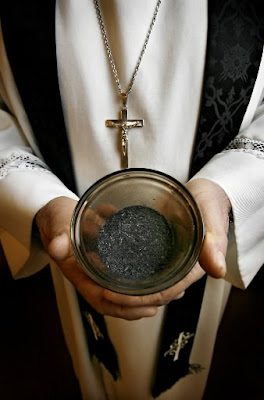
Ash Wednesday introduces the season of repentance -- with prayer, alms-giving, fasting as the traditional pillars.  Every religious tradition I have studied -- and I've not only been researching religions since I was a teenager, but had the opportunity to teach a Religious Studies curriculum for 6 years at a former job, so I've covered quite a few -- every religious community has some way of marking time, of structuring the cycles and patterns of life, something akin to a liturgical year, in which narrative intersects with and is enacted within calendar, where feasts or fasts for some at least are prescribed or proscribed, where space and time, and even silence for self-reflection is opened, where the theme of sin, distance from God and from neighbor, from the persons we ought to be (and study of actual world religions, in their practice, in their scriptures, will tell you that the notion of sin is a lot more widespread than some polemically maintain), becomes a focus.  Sin is multiform and multifaceted, and may be grasped by numerous holds, some of them intellectual, some of them much more affective, some more global, involving universal experiences and conflicts, others so personal that the one holding them within may doubt whether anyone else has ever felt, suffered, done, and regretted what -- or like --  they have.  And all of those complexities and stances, realizations, and progressions and degenerations of moral life are rolled up, implicitly, into the ordering of Ash Wednesday, and Lent, and the Passion, and Easter and . . . .

I pray the Liturgy of the Hours (these days using iBreviary) -- at some times of my life diligently, at others desultorily -- or better put, since I hardly feel as if I'm praying them, I read them, I speak them, or I sing them.  This is another one of those complex intersections of text, ritual, daily practice, tradition of whose depths and fertility some Evangelicals, among others, are becoming aware and enamored.  The Liturgy consists in arranged prayers, many of them Psalms, read at given points in the day. There is a cycle to it, where canticles and verses, Scripture readings and commentaries (in the Office of Readings) bob and weave, dance and chant their ways in and out of the weeks and months.  The Liturgy of the Hours is a complex pattern woven largely out of Scripture, and if one desires or aims to know Scripture better, particularly the Psalms, it is highly recommendable.

Mar 6, 2011

Saint Anselm on Anger (part 3)

The last two Sundays, I posted installments of serialized set of posts, part 1 and part 2 of a longer study of how anger fits into Saint Anselm's moral theory.  That study in its turn forms part of a broader-scope, ongoing set of examinations of anger (and connected topics) as understood by philosophers, theologians, psychologists, and (perhaps later) literary figures, ultimately intended to be housed in books (one of which, dealing with Aristotle on anger, I'm working on currently). Here, in this format, I work out and provide for interested readership the shorter, more preliminary studies of anger that later find their way into more systematic, academic manuscripts.

The last post on Anselm identified four Anselmian virtues bearing on anger:  patience, meekness, humility, and justice, and noted that each of these virtues was a particular habitual and dispositional structure of the human will, instantiated not only in the uses the human person chooses to make of his or her will, but even more so in  lasting affective currents of desire, fateful shaping, character, what Anselm calls will as affectio.

In order to better understand virtues, and their opposite, vices, we have to understand the will, and that requires us to understand a number of other interrelated matters.  There are good reasons why we human beings are so often mysteries to ourselves even when we think we best understand and know ourselves, and Anselm touches on this while mimetically representing what must have been a common enough occurrence in his life and teaching, begging off from giving his views and rational reflections on a divine mystery in Cur Deus Homo:
we need an analysis of ability and necessity and will and of other notions which are so interrelated that no one of them can be fully examined apart from the others. . . . For an ignorance of these notions produces certain difficulties which become easy to deal with as a result of understanding these notions.

Feb 5, 2011

Anselm's Similitude Between the Heart and a Mill

Deciding to prolong the pattern of my posting from last week, in which I provided an English translation of a passage from the Dicta Anselmi, here is a short chapter from the De Similitudinibus/De Humanibus Moribus, one of St. Anselm's most popular works.  This is one of my long-favorite similitudes -- Anselm was well known for teaching all types of people by means of well-crafted metaphors -- and it compares the human heart to a mill, grinding various grains for our sustenance.  I particularly like the realization that our minds are constantly preoccupied with something.  Anselm was particularly happy when he was able to devote time to contemplating the divine mysteries -- in fact, his famous Proslogion argument (a portion of which gets termed the "ontological argument") emerged from many hours devoted to such activity.

The startling image I've added here, from The Lion and the Cardinal, depicts a scene reminiscent of Anselm's analogy:  the four Evangelists pouring scripture into a great mill, which provides sustenance for all, the four strips of verses being fused into one, that diatesseratic verse itself flowing into the hand of the Logos, the incarnate Word
Chapter 41.  A resemblance between the human heart and a grinding mill
Indeed, our heart is similar to an ever-grinding mill, which some lord gave to one of his servants so that he might guard it, prescribing for him that he should grind his provisions, namely grain or barley or even wild oats, in it, and live on what he has ground.  Truly, one who always plots against this mill behaves as an enemy to this servant.  When this enemy finds the mill to be empty, he either straightaway casts sand into it, which wears it away, or pitch, which gums it up, or something else which soils it, or fills it up with chaff.

So, if this servant guards his mill well, and grinds in it so much provisions as his lord gives him for sustenance, then clean flour of each kind of provision, ground up in the mill, will come out of that same mill.  And, precisely because he grinds, and serves his lord, he acquires for himself his means of life.  But, if he permits his enemy to mess up [violare] his mill, bad flour will come out of it, since the provisions he grinds are bad.  But, this flour greatly displeases that lord, and the servant does not gain his means of life, but rather instead hunger.

Now, this ever-grinding mill is the human heart, assiduously thinking about something.  And God apportions it to each of his human servants, commanding that they turn over and over such thoughts as he himself suggests to them.  And of these thoughts, some are like grain, others like barley, and others like wild oats.

Nov 14, 2010

Anselm on Persons In God's Mind (part 2)

Two weeks ago, in one of my Sunday musings, I posted some reflections bearing on some of the implications of a tripartite distinction the  great Medieval thinker St. Anselm made.  This was what we'd call an "ontological" or "metaphysical" distinction, meaning that it has to do with the being or reality of things.  The distinction bore on the modes of being or reality of a thing, the way a thing is or exists.

There is the thing as it actually is, in itself, real, existing.  And then there is how it is in our mind, in our knowledge, or imagination, or memory of the thing, even in our language, perhaps even in a painting of it.  The thing does exist this way, but with a lesser degree of reality or being than the thing as it is in itself.  Then there is the thing as it is in God's mind, in God's knowledge of it, which like every other genuine divine attribute for Anselm (e.g. God's goodness, His eternity, His justice) is in fact what God is, entirely so (so God is His justice, eternity, knowledge).

Three things to say about this.  First, it might be helpful to think of an example.  Second, this whole perspective, which may seem very strange and counter-intuitive, is a perfectly respectable philosophical stance which we call Platonism or neo-Platonism, and Anselm does definitely fit that label. Third, from that perspective, there is a hierarchy of degrees of being, and for a Christian (or for that matter Jewish or Islamic) neo-Platonist, from low to high it goes like this:  how a thing is in our minds, an image; how a thing is in itself, as it exists; and how a thing (most truly, most genuinely) is in God's mind.

Let's take an example:  there's a vase.  It is made of marble.  It came into being, say, 500 years ago, formed by the hand of a craftsman.  It is real.  You touch it, hold it in your hands, feel the coolness and smoothness, run your eyes over it.  Now, imagine it.  What's in your mind?  That same vase, or rather an image of it.  An image which has less reality, less truth than the actual thing itself of which it is a more or less faithful copy.  That has a lower degree of being.  And, then there is the vase as it is in God's mind, existing in there with all of the rest of the world, eternally.

Oct 31, 2010

Anselm on Persons in God's Mind (part 1)

Saint Anselm makes a very interesting distinction at several points in his writings.  He contrasts how things are in our thought, language, or knowledge about them with how things actually are in themselves.

Such a contrast between reality and appearance, or reality and representations of reality, is a commonplace found in nearly all philosophical approaches, even in those which accord priority to perspectives rather than to realities.  Anselm goes further, however, introducing a higher, or better put deeper, level: there is how things are in our knowledge of them, how things are in themselves (in se), and how they exist, as he puts it, in the divine Word, i.e. how they exist in the mind of God.  Here is one of several key passages (in Hopkin's and Richardson's translation:
Now, it is evident that the more truly the Creating Being exists than does the created being, the more truly every created substance exists in the Word (i.e., in the Understanding) of the Creator than in itself. Therefore, how would the human mind comprehend what that kind of speaking and knowledge is which is so vastly superior to and truer than created substances, if our knowledge is as vastly surpassed by these [created] things as their likenesses are different from their being?

Oct 10, 2010

Anselm's God, the Sun, and the Unfathomable Ocean

At the end of (though technically at the beginning) of weeks simply saturated by concerns of faculty development, business ethics, course design, the CLA, my three sections of Critical Thinking this semester, articles on disparate topics I committed to, and seemingly endless meetings, I want. . .  better put, I need to read, think, and write about something other than those matters.  I had hoped Sundays after mass I would make time to start reading my way piece by piece through the volumes of the writings of the Church Fathers I bought on a bargain four years back.  But, inevitably, undone work and unfinished products from the previous week intrude.

Unable to stick to my first intention, I decided on a plan which would combine some sabbatical conversation with great Christian thinkers but which would also tie in with my current projects.  I made my bones a while back as an Anselm scholar, and continue publishing articles, giving talks, and even writing a book on his thought. My Anselmian explorations have had to be placed on hold so far this semester (except to write an application for an NEH Summer Stipend to work on the book), so Sundays will provide the space and time to follow along with the great Benedictine saint and philosopher.

One of the paradoxes of Anselm's theocentric writings is that in them he tells us that God is both known and unknown, that we can have an idea of God, but not comprehend God, that in fact our language even at its most theologically precise can just barely gesture towards God.  Anselm has been called everything from a rationalist to a mystic.  Both labels do apply, in fact (if they are not understood exclusively), because in Anselm they are not opposed but complementary, and this is precisely because of the object his thought strives towards, the person he communicates with, the ultimate reality he extends his mind, human language and concepts, to grasp:  God.