Showing posts with label modern philosophy and modernity. Show all posts

May 6, 2020

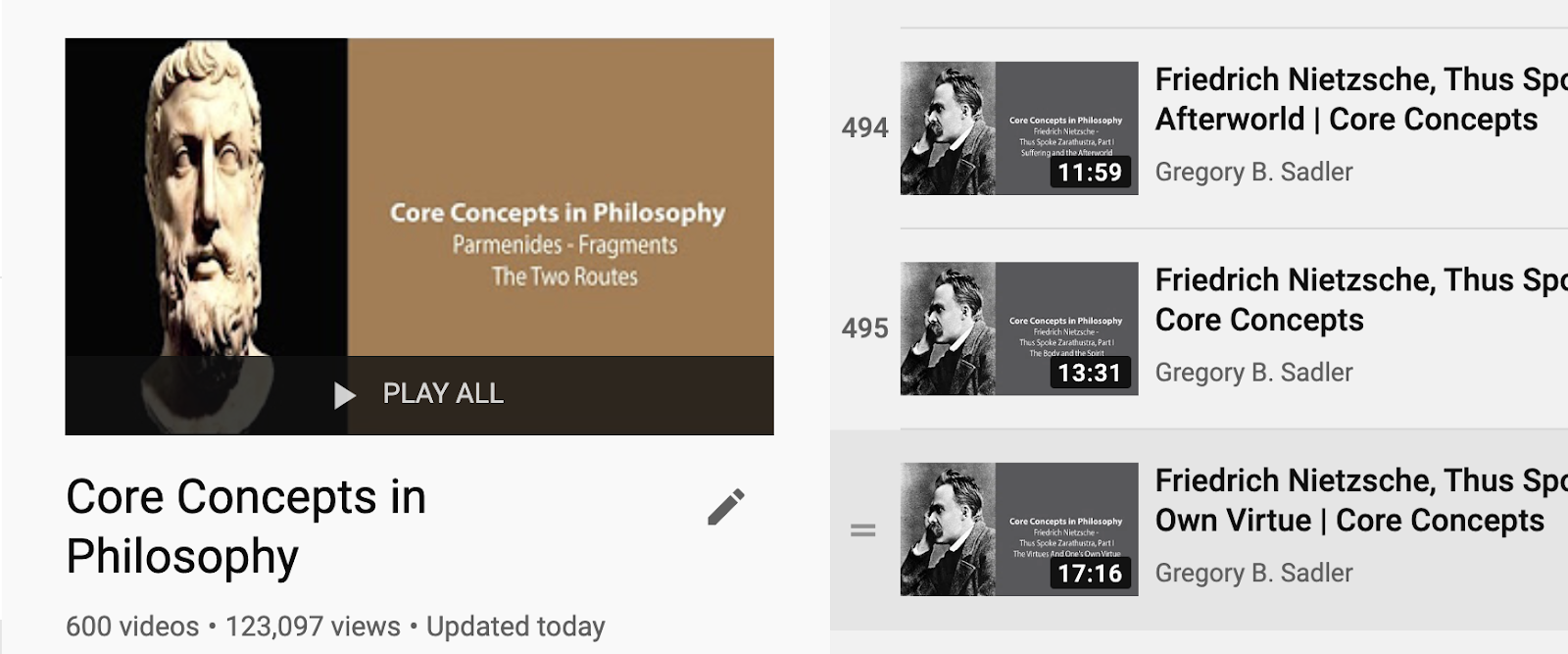
Core Concept Playlist Split into Five Playlists


For years, I have been producing shorter (10-25 minute) videos on key ideas, distinctions, arguments, and topics in philosophy.  I use these routinely as a resource for my students in classes that I teach. 

Many other people use them as well.  Students in other people's classes watch or listen to them to help them understand their assigned material.  Lifelong learners use them to study or just brush up on philosophy.  Professors sometimes assign them to their own students, and I've even had some instructors write to tell me that the videos helped them prepare their own class notes, lectures, and discussions!

I used a YouTube playlist to gather them all together into one place, and that worked all right for a while.  But some time back, I passed the 600-video mark in that playlist, and it began to develop some glitches (which is actually not bad, since YouTub officially says don't put more than 200 videos in a playlist!), so I've been kicking around the idea of splitting the one massive playlist into five more manageable ones.

What kept me from doing that for the time being was the work involved.  It means going in manually and moving all of those videos around.  So I've been putting it off for quite a while.  But today, I bit the bullet, put in the hours of work, and now all five are ready for prime time (or whatever the equivalent is for YouTube!).  With no further ado, here they are (click on the link to see the actual) playlists).

  • Ancient Philosophy - 340 videos on Parmenides, Zeno of Elea, Plato, Aristotle, Epicurus, Cicero, Seneca, and Epictetus
  • Medieval Philosophy and Theology - 64 videos on Augustine of Hippo, Anselm of Canterbury, and Thomas Aquinas
  • Modern Philosophy - 80 videos on Rene Descartes, Blaise Pascal, David Hume, Jeremy Bentham, and Immanuel Kant
  • 19th Century Philosophy and Literature - 70 videos on G.W.F. Hegel, Soren Kierkegaard, John Stuart Mill, Leo Tolstoy, Fyodor Dostoevsky, Friedrich Nietzsche, and William James
  • 20th Century Philosophy and Literature - 127 videos on A.J. Ayer, Martin Heidegger, Rainer Maria Rilke, W.D. Ross, Gabriel Marcel, Jean-Paul Sartre, Simone de Beauvoir, Albert Camus, Ruth Benedict, Hannah Arendt, Ayn Rand, John Rawls, George Dickie, Ursula K. Leguin, Lawrence Kohlberg, Virginia Held, Alasdair MacIntyre, Mary Midgley, James Rachels, Rosemarie Tong, and Peter Singer

That's 681 total core concept videos - quite a lot!  As I look at it, I'm pretty sure that I'll need to split that first playlist again sooner or later (most likely into everything before and including Aristotle, and everything after him).

So if you're looking for short, on-point, accessible but rigorous videos on any of these thinkers, you can now much more easily find them.  Just click on the relevant playlist and you'll be able to see everything I've got available in that format.

Jan 31, 2020

Eleven Podcast Episodes on Descartes' Meditations


I have been converting my core concept lecture videos into podcast episodes in the Sadler's Lectures series.  So far, I've created series on Plato's works - the Apology, Crito, Euthyphro - and on other works by Aristotle, Cicero, Epictetus, Kierkegaard, Rilke, and Sartre.  Recently, I created my longest series yet, going through the entirety of Rene Descartes' Meditations on First Philosophy

Here below is the first half of that series.  The thirteen episodes in this set cover the key ideas and arguments from the first three meditations, and run about 2 1/2 hours total.  You can download any or all of them, and listen to them anywhere you'd like to.


Rene Descartes, Meditation 1

Nov 19, 2019

Philosophers in the Midst of History Year 5 Scheduled!


Earlier this month, we had the final session for this year in the Philosophers In The Midst of History public talk series, discussing the 20th century existentialist and feminist thinker, Simone de Beauvoir (watch the videorecording here).  She is probably best known for her work The Second Sex, but we also devoted some discussion to another important book of hers, The Ethics of Ambiguity.

That session was number 16, which brings a close to the fourth year of this quarterly series.  We already have a fifth year scheduled, hosted again at the Frank Weyenberg Library (located in Mequon, Wisconsin), and we'll be doing a bit more public promotion of these events in the year to come.

I imagine that my readers are probably more interested in what thinkers we'll be covering next year than in the details about planning and public outreach, and I'm happy to be able to announce them.

For the Ancient period, we'll be focusing on Epicurus.  We've already discussed Plato, Aristotle, Cicero, and the Stoic philosopher Epicteus, so it's about time we bring in some discussion of the founder of this major philosophical school of antiquity.

For the Medieval period, I decided that it would be interesting to discuss a rather controversial figure.  I don't mean Abelard, Scotus, or Ockam (I did consider doing Abelard and Heloise) - but rather the 13th-14th century German Dominican philosopher and mystic, Meister Eckhart.  That focus will provide a nice supplement to the talks already given on Augusting, Boethius, Anselm on Canterbury, and Thomas Aquinas.

For the Modern period, we'll be looking at the all-too-often neglected philosopher Mary Wollstonecraft.  She's someone I teach frequently and occasionally give talks on, and I'm hoping that preparing this lecture might also provide me with the needed impetus to get some papers on her I've been working on for several years brought to fruition and sent out for publication.  We've previously focused on Thomas Hobbes, Rene Descartes, John Lock, and Jean-Jacques Rousseau in that time-period.

We end each year with a philosopher from the 19th or 20th century, and this time I thought I'd give it a bit of a twist, discussing someone who clearly is a philosopher, but whose works tend to be read more outside of that discipline, the great French writer, Alexis de Tocqueville, who, among other things authored works exploring the French Revolution, the American prison system, and the nature of American democracy by contrast to European democracy.  This will add him to the four thinkers from that period we've already covered, namely Friedrich Nietzsche, Albert Camus, Hannah Arendt, and Simone de Beauvoir.

If you'd like to watch or listen to any of the previous 16 sessions - they're roughly 75-90 minutes or so in length - here's the YouTube playlist of the series.

If you're in the area, and you'd like to attend, you might want to mark your calendar - the talks will be coming up at 6 PM on February 5, May 6, August 5, and November 4, hosted at the Frank Weyenberg Library.

Nov 12, 2019

Seven Videos on Rene Descartes' Meditations 5 and 6


This Fall, I was able to fill in a gap in coverage of videos I originally created for students enrolled in the classes (Intro to Philosophy, Foundations in Philosophy) in which we focus on Rene Descartes' massively influential work, the Meditations on First Philosophy.

The previous semester, I managed to find the time to produce core concept videos covering the first three meditations, but wasn't able to get to the fourth, fifth, and sixth.  That was remedied a few weeks ago, as I finished up the set, now covering the entirety of the Meditations.  There are 22 videos total in that series.

Just earlier this week, I released the last of these videos to the general public.  I've since moved on to creating new content bearing upon other texts and thinkers we're studying in my classes this Fall - David Hume's Enquiry Concerning Human Understanding, A.J. Ayer's Language, Truth, and Logic, and William James' Pragmatism, among others.

For those who would like to work their way through the last of Descartes' Meditations, here are those seven new videos:

Meditation 5

Meditation 6

If you're looking for more content on Rene Descartes's works, or just trying to find the full series of 22 videos on this work in particular, you should check out my Descartes playlist (with 42 videos, and about 18 hours of content)

Nov 10, 2019

The Core Concept Playlist Reaches 600!


Earlier this year, we hit a milestone for one of my video series.  The Core Concept playlist reached the 500 video mark back in March, and we celebrated with an online party, hosted on YouTube Live. We've now reached another milestone - though I don't plan to do another party for a while - with the public post of video #600 in the series

I first started creating these shorter, more single-issue focused videos as learning resources for students enrolled in my face-to-face classes (at that time at Marist College).  It didn't take long before I realized two things.  First, they could be even more useful for the online classes I was beginning to teach and to develop.  Second - as was the case with my other videos - students, lifelong learners, and even other instructors all across the world were watching the new videos and using them as resources.

My selection of what texts and thinkers to focus upon for the core concept videos has been driven primarily by the needs of my classes.  Each semester I try to add some new content, and - provided I actually have the time - I'll create new videos on that new material.  Sometimes that leads to a lot of videos, enough to cover entire works like Aristotle's Nicomachean Ethics, Rene Descartes' Meditations, or Immanuel Kant's Groundwork for the Metaphysics of Morals

Every once in a while, if I have enough time on my hands, I'll shoot a sequence of core concept videos on a thinker whose work deserves the in-depth video treatment, but which I don't have any immediate plans to teach.  So for example, some time back I shot an entire sequence on Aristotle's short work, the Categories.  Last Fall, I created a few videos on Pascal's Pensees.

At this point in time, here are the thinkers on whom I've got at least one core concept video available:

  • Ancient Philosophy:  Parmenides, Zeno of Elea, Plato, Aristotle, Epicurus, Cicero, Seneca, Epictetus
  • Medieval Philosophy: Augustine, Anselm of Canterbury, Thomas Aquinas/
  • Modern Philosophy: Rene Descartes, Blaise Pascal, David Hume, Jeremy Bentham, Immanuel Kant
  • 19th Century Philosophy: G.W.F. Hegel, Soren Kierkegaard, John Stuart Mill, Friedrich Nietzsche, Fyodor Dostoevsky
  • Early 20th Century Philosophy: Martin Heidegger, Rainer Maria Rilke, Gabriel Marcel, Jean-Paul Sartre, Simone de Beauvoir, Albert Camus, W.D. Ross
  • Later 20th Century Philosophy: Ayn Rand, Ruth Benedict, Alasdair MacIntyre, Lawrence Kohlberg, Virginia Held, James Rachels, and Rosemarie Tong
If you'd like to look around through the Core Concept Videos playlist, click here, and you'll have access to those 600 free videos!

Nov 5, 2019

Session #16 in Philosophers in the Midst of History Tomorrow!


After we moved back here to Milwaukee, we partnered with several area libraries to provide talk series connected with philosophy.  We're now nearing the end of year 4 in two of those series.  One of them is the monthly Worlds of Speculative Fiction, hosted at the Brookfield Library.  The other is the quarterly Philosophers in the Midst of History, hosted at the Frank Weyenberg Library in Mequon.

In that second series, I discuss an ancient philosopher in the Spring, a medieval philosopher in Summer, an early modern philosopher in Fall, and a late modern philosopher in Winter.  This year, we finish up the year with a talk focused on the French existentialist and feminist author, Simone de Beauvoir.  So if you're in the Greater Milwaukee area, free around 6 PM, and looking for a stimulating discussion, you might want to drop in!

We videorecord all of the talks in the series, so if you've missed the other sessions, and would like to learn about these philosophers, their historical context and background, and how they contributed to history themselves, here are those 15 videos:

Nov 4, 2019

Eight Videos on Rene Descartes' Meditations 3 and 4


Most semesters - since I tend to teach Introduction to Philosophy (sometimes called by a different title) - I cover the entirety of Rene Descartes' work, the Meditations on First Philosophy.  Whether you love him or hate him (and I love Descartes), think he's got things right or wrong (and I think he got a lot wrong), you've got to admit that he's a centrally important figure in Philosophy's living history and traditions.

I was very surprised to learn - through Twitter conversations - that many students never encounter more than the First and Second Meditations in their classes!  Not only did a lot of students report that, but also quite a few instructors admitted that they taught the first third of the work, and then either skipped the rest entirely, or jumped way ahead into a few bits of the Sixth Meditation.  Later on, when I've got some time on my hands, I'll write up a piece about why this is such a bad pedagogical strategy, what mistaken ideas about Descartes it implants, and what interesting features of Descartes' thought it deprives students from engaging.

We cover the entire work, and this semester, I've remedied the previous lack of core concept videos covering the main ideas of the Fourth, Fifth, and Sixth Meditations.  I provide these as resources for my students in both my online and my face-to-face classes. As I've been releasing them to the much more general public worldwide, it's clear from the video comments that teachers, students, and lifelong learners have been finding them useful as well.

Here are those eight videos:

Third Meditation:

Fourth Meditation:

Jul 8, 2019

Three Videos on David Hume's Treatise of Human Nature


I teach David Hume's works from time to time.  In fact, he made his way into my classes quite early on in my career.  My very first Ethics classes included some portions of his Treatise of Human Nature, and the first time I taught Intro to Philosophy his Enquiry Concerning Human Understanding was a required text. 

I incorporated that Enquiry into my Foundations of Philosophy sections (at Marquette University) and my Intro to Philosophy class (at Milwaukee Area Technical College) this last semester, but - alas! - couldn't carve out the time to shoot footage for the core concept videos I'd wanted to produce on that text.  I did, however, manage to shoot a bit of material on the Treatise for my online Ethics class at MATC this summer.

One of Hume's most famous passages is where he claims:
We speak not strictly and philosophically when we talk of the combat of passion and of reason. Reason is, and ought only to be the slave of the passions, and can never pretend to any other office than to serve and obey them. 
That is from book 2 of the Treatise, part 3, section 3, and it fit in quite well to the section on non-cognitivism and emotivism in my class.  So I decided it was about time I created some Hume content for my students. Later this summer, I'm planning on shooting some additional videos on the Enquiry as well.

In any case, here are those three videos:
I hope you find them interesting and useful!

May 17, 2019

Seven Videos on Fyodor Dostoyevsky's Notes From Underground


My summer 6-week Existentialist Philosophy and Literature class, designed and taught for Milwaukee Institute of Art and Design, is now nearing the end of its first week.  We are spending about five of those weeks going through selections from 10 key authors in the existentialist movement.  One of the thinkers we are hitting early on - next week in fact - is Fyodor Dostoevsky.

I've assigned the students Part 1 of Notes From Underground, with a chapter from The Brothers Karamazov (The Grand Inquisitor) as a supplemental text.  I like to provide students with a lot of resources in all of my classes, and in online classes, this is particularly crucial.  So, I produced a series of core concept videos going through the key ideas set out in Notes from Underground.

Here are those seven videos:


If you find the philosophy resources I develop interesting, enjoyable, or useful, by all means share them with others. And if you'd like to support the work that I do, making philosophy publicly accessible, you can become a monthly supporter on my Patreon page, or if you prefer a one-time donation, you can Buy Me A Coffee!

Apr 7, 2019

Why Stop With Descartes' Second Mediation?


Here's a topic that I'll flesh out more fully in a fuller-length piece in my Medium site, hopefully later on this week - something that came first as a complete surprise to me, and then transformed into understandable dismay:  apparently, it is quite common for philosophy instructors to assign and teach only the first two of Rene Descartes' six Meditations on First Philosophy.

I discovered this when posting my recently released core concept videos focused on that very work.  People made comments that I thought were rather strange on the videos themselves and in the social media where I posted those videos.  Comments that sounded almost as if the people making them were familiar with Descartes' methodological doubt, the idea of the evil demon deceiving us, and the notion of the human being as thinking substance - but had no idea about all the other key ideas, arguments, distinctions that followed in the work.

When you stop short at that point in the work, then Descartes appears as a super-skeptic, or at the very least a skeptical idealist.  What ends up getting left out are: discussions about where our ideas come from, and whether we could be their unwitting source; an interesting argument for God's existence (and very much the "philosopher's God"); the invocation of clear and distinct ideas or conceptions as an epistemological criterion; consideration of how ideas can be true or false and where in the use of faculties falsity arises; an ethics of the use of the mind; exploration of the stock of innate ideas we have at our disposal; another, ontological argument for God's existence; reconstruction of the entire external world of extended substances. . .  and a few other things.

Why would a philosophy instructor who is good enough to their students to assign Descartes' Meditations only have them read the first two?  Surely it can't be because that instructor only read that far when they were a student, right?  Is it because they are uncomfortable with the "God-talk" that features heavily in Meditations 3 and 4?  It's not as if there isn't already a good bit of that in the earlier meditations.  Can it be that they think there is some legitimate pedagogical purpose served by reading just the start of a work then ignoring where the rest of that work goes, how the conclusions differ from the starting points, whether the problems raised find some resolutions?  That's hard to fathom as well

This bears more reflection on my part, which I hope to get to later this week.  I'll likely ask instructors who do teach just Meditations 1 and 2 in my social media whether they can provide some illumination on this matter as well.

Mar 10, 2019

A Milestone - 500 Core Concept Videos!


Years back, I started producing a new kind of video, in a series I called Philosophy Core Concepts.  After seeing the hour-long videos I recorded in my Critical Thinking, Introduction to Philosophy, and Ethics classes take off, I started thinking about other sorts of videos I might produce that would be useful for my students and for other viewers worldwide.

There were already quite a few short (anywhere from 2-10 minutes), often quite high-production videos on topics and thinkers in philosophy.  But in my view, they were pretty hit and miss.  Some of them could be quite good.  Many of them were actually poorly informed, misleading, or biased.  And then, there were a lot in between.  That's not surprising.  Two things are needed to successfully teach about philosophy in videos.  You've got to really know what you're talking about.  And you've got to give people enough actual content - which then requires a longer amount of time.

I decided to stick with my low-tech, minimally produced approach - if the content is actually engaging, even without animations, sound effects, and the like, people will want to watch it - and started creating these new Core Concept videos.  They range between 10-30 minutes in length.  In format, it's just me in front of the chalkboard, presenting one key idea, distinction, argument, account or other bit of philosophy, from some important thinker.

You can see the entire playlist by clicking here.  Scroll down and you'll find a number of videos on a variety of philosophers from Ancient, Medieval, Early Modern, 19th Century, and 20th Century philosophy.  So far, I've created videos on Plato, Aristotle, Epicurus, Cicero, Seneca, Epictetus, Augustine, Anselm, Thomas Aquinas, Rene Descartes, Blaise Pascal, Jeremy Bentham, Immanuel Kant, G.W.F. Hegel, Soren Kierkegaard, John Stuart Mill, Friedrich Nietzsche, Martin Heidegger, Jean-Paul Sartre, Albert Camus, W.D. Ross, Ayn Rand, Alasdair MacIntyre, Viriginia Held, James Rachels, and Rosemarie Tong.

Over the years, I have invested in better lighting, a voice recorder, and a superior camera, but I've kept the approach consistent.  Short videos with me lecturing engagingly in front of a chalkboard with notes on it.  I plan to keep on shooting these - they're a valuable resource for the classes I teach, and other people find them useful as well - expanding the series well past the 1,000 video mark.  There are quite literally hundreds of texts and dozens of additional thinkers I'd like to cover.

A bit later today, I'll be hosting a YouTube Live session to celebrate this milestone with my viewers, fans, and subscribers.  If you'd like to join in on that - and get to vote about the area you'd most like to see me focused on for videos in the near future - you can click here to find out more (and set up a reminder for yourself). 

On a final note, if you'd like to support my ongoing work in producing these valuable educational resources, there's two ways you can do that.  To become a monthly supporter, click here to go to my Patreon page.  If you'd like to make a one-time donation, you can do that here through Paypal.

Feb 18, 2019

Eight Videos On Blaise Pascal's Pensées

Some time back, I decided to shoot some core concept videos on one of my favorite books of philosophy, Blaise Pascal's unfinished but brilliant work, the Pensées.  It's a work that I first encountered back in graduate school, and have often drawn upon, but don't often have a pretext to teach (perhaps I should find one!) in my classes.

The Pensées is a pretty lengthy and quite complex work, so what I've done in these seven videos is in some respects just scratching the surface.  Some of the ideas and arguments, though, are among those Pascal is best remembered for.  I hope eventually to return to the text and produce a number of additional videos covering key ideas and distinctions in it.

For the time being, here are those eight videos

May 5, 2018

Nine Videos on Descartes' Discourse on Method

A few years back, I created a one-off video in my Core Concept series on Rene Descartes' famous four "rules of method".  I was developing resources for students in my online World Views and Values class at Marist College (there's also an inexpensive open-enrollment version of that class you can check out or enroll in), and I noticed that some of them were getting a bit confused about the Cartesian approach.  So I shot that video, intending eventually to create more content on Descartes.

My viewers and subscribers liked that video, and for quite some time have been asking me when I would start producing more content on Descartes.  So last month, I managed to set aside the time to shoot eight more videos on the Discourse on Method, creating an entire series covering most of the key ideas and passages of that work.

Here are the links to those nine videos:

I do have to caution that these videos are not intended to substitute for actually reading the work.  In the case of the Discourse, you really don't want to deprive yourself of the experience of reading Descartes.  He's a very clear and readable writer, and it's a rather short work designed specifically to introduce his thought to a general public (he deliberately wrote it in French, rather than the Latin of many of his other works).

Later on down the line, I hope to also produce a whole slew of new videos on two other works by Descartes: his Meditations on First Philosophy, and his Passions of the Soul.  If you'd like to support my ongoing work - or if you find my videos valuable, and just want to give back a bit - consider becoming a Patreon supporter on my page.

Apr 17, 2018

Not Just What - But When - Should We Doubt?

For years I have taught a course online for Marist College, called World Views and Values.  It's essentially an Introduction to Philosophy course, with a bit more emphasis set upon the conception of the world, the social and political sphere, and human nature.  Starting out as a 10-week course, in the last year or so, it has been shortened to an 8-week term - so it's a pretty intense experience for students in the school of Professional Studies, who often have had no background in philosophy.

In the course, we spend one week going through Rene Descartes' Discourse on Method - concentrating mainly on parts 1-4 of the work, but looking as well at the discussion of human beings, machines, and animals in part 5. One key theme of Descartes' work is doubt.  He employs what is called "methodological" or "hyperbolic" doubt as a tool - that's absolutely distinctive to his approach.  And, of course, there are a number of lingering worries that can be raised once Cartesian doubt is introduced.

(I should mention - as a side note - that if you're interested in taking an open-enrollment version of that course, based on the earlier 10-week format (which included more content), I offer it in the ReasonIO Academy at this link - Philosophical World Views and Values).

My students enrolled in the Marist course not only study the text, watch lecture videos, download resources, read through lesson pages, and do some writing assignments.  A main dimension of the class - both in terms of their grade (which they definitely care about!) and their learning - develops through their participation in discussion forums.  And one of the questions I ask them - to provoke conversation among my students - is "should we doubt everything?"

Apr 6, 2018

Descartes And The Third Class of Person

Readers typically encounter Rene Descartes through one of two of his main works. It's either the Discourse on Method or the Meditations on First Philosophy.  Both provide some of the same outlines, insights, and even arguments central to Cartesian philosophy, but they do so in quite distinct manners.

In the Discourse - the one I focus upon here - Descartes begins by telling us the story of his own education, or more properly speaking, the narrative of his quest for knowledge that he could be certain about and thereby orient his life by.  This tale is in its broadest traits one we are all familiar with.  It furnishes the basic plot structure to many movies, shows, stories, and even songs in our own time.

A person starts out young, naive, and talented.  Endowed with a quick intellect, but not knowing much of anything at the start, he applies himself to the studies set before him by his teachers, and he excels.  But as he thinks over what he has learned, and as he compares it to what he learns through living and observing the world outside the school, worries and doubts begin to get their grips in him. 

This student has learned widely within, perhaps even mastered, what are acknowledged to be main subjects - domains of knowledge - but he comes to suspect and then realize that what he possesses does not amount to genuine knowledge.  It's not - to use the master-metaphor Descartes makes recourse to - a solid foundation upon which a lasting and secure edifice can be progressively constructed.

What then?  How will the hero of our story attain the object of his desire?  We typically telescope the narrative at this point - making it easier upon our students, or perhaps also ourselves - and move straightaway into the Cartesian method and the chain of arguments found in short form in the Discourse and in much greater depth within the Meditations.  Let's not do that here.

Nov 27, 2017

November Philosophy Pop-Up Sessions

Since August, I've been engaging in a new sort of interaction with my various subscribers, fans, and followers - Philosophy Pop-Up sessions.  These are streaming sessions, hosted monthly on YouTube Live and Facebook Live.  Participants can watch or listen, and have the chance in real time to ask questions or leave comments, to which I do my best to respond.

I schedule each of these for one hour, but they sometimes go a bit longer.  Originally, the goal was to make them a good bit shorter - closer to 30 minutes in time - but as it turns out, people didn't want the sessions to end as quickly as intended!

The November sessions were devoted to a thinker I talked about quite a bit this month - Friedrich Nietzsche - and specifically to the "three noble responses to the problem of life" laid out in his book The Birth of Tragedy.  If you missed them, here they are:


As always, these sessions are underwritten by the generous support of my Patreon backers.  If you'd like to learn more, or to start supporting the work I do making philosophy accessible world wide, go to my Patreon page!

Oct 19, 2017

Ten Videos On John Stuart Mill's Utilitarianism

One of the most commonly taught texts in Ethics classes is John Stuart Mill's classic work, Utilitarianism.  I give it a central place in my own classes, generally as a companion text to Jeremy Bentham's founding work for utilitarian moral theory, The Principles of Morals and Legislation.  Together, they provide a great overview of that approach in ethics.

Students do struggle with Mill's work, so some time back, I started creating short Core Concept videos specifically on Utilitarianism.  The first few of these, I actually shot during my class discussions.  Then, a few years ago, I created several additional videos.  I provided the entire set to my students - in both face-to-face and online classes - as a resource to help them through the text.

Since I'm now once again in the classroom - teaching two sections of Ethics for Marquette University this semester - I thought I'd add a few more videos on key ideas of Mill's Utilitarianism.  As it turned out, there were four topic that I thought needed additional discussion.  This brings the total number in to ten - enough to cover all the main ideas of the work.

Here is the full set of videos on John Stuart Mill's Utilitarianism.
I hope they prove useful for you as you read - or reread - Mill's work.  And if you find it helpful for you, consider passing this post on to other people you think might find it helpful.  If you'd like to support the work I do, making philosophy accessible to the general public, take a look at my Patreon page.


Jul 7, 2017

Video Series - Immanuel Kant's Groundwork of the Metaphysics of Morals

Immanuel Kant is one key thinkers I focus on in my classes.  I'm not by any means a "Kantian" - in fact I disagree with him on a number of matters - but he is someone whose works I very much appreciate, and even enjoy grappling with.  He is also someone whose thought tends to be very difficult for students approaching him for the first time - or even rereading his works! - and in my view, this difficulty stems from two main sources:  his academic terminology and style, one the one hand, and the systematic structure of his thought, on the other.

The first obstacle for students is figuring out what Kant is actually saying - and it is entirely understandable that they would encounter serious difficulties and frustrations when attempting to make sense out of what they see on the page!  Once they do understand just what all the jargon means, then there is the further difficulty involved in wrapping their minds around what Kant is proposing, arguing, criticizing, distinguishing.

If you've ever tackled Kant's Groundwork of the Metaphysics of Morals - or if you'd like to try your hand at one of the most important and influential works of Ethics - then I have something you might find very useful, a series of 21 short videos covering the entirety of that very work!

Originally, I created these core concept videos to assist my face-to-face and online college students get more out of their study of Kant's deontological moral theory in my classes.  Some of the early ones in this series were actually recorded in the classroom.  Then, I began producing additional ones in front of my chalkboard in our old apartment in New York. The last nine videos were shot and uploaded more recently.  So, you'll notice that the later ones have higher video and sound quality - but the content is all quite solid!

Sep 28, 2015

Starting the Master-Slave Dialectic


More than a year-and-a half-in, the Half-Hour Hegel project continues on strong!  I've just released the 74th installation in this video lecture series -- aimed at providing an innovative, open-access, digital commentary on G.W.F Hegel's first major work, the notoriously difficult Phenomenology of Spirit.

I usually provide updates about the project and matters Hegel-related on the Half-Hour Hegel blog, but since the Master-Slave dialectic is a particularly popular selection from the work -- and that's what we're about to start --  I thought it would be worthwhile to mention it here in Orexis Dianoētikē.

If you're interested specifically in that section of the work here's the video lectures so far from the "Lordship and Bondage" portion:
If you'd like to see the other videos from the Self-Consciousness portion that the Master-Slave dialectic fits into, I suggest going over to this page on the Half-Hour Hegel blog, where all the video lectures are curated as soon as I shoot, edit, upload, and release them. 

Next week, you can expect to see videos specifically discussing the paragraphs in which Hegel elaborates the Master-Slave dialectic proper -- if you follow me on Facebook, Twitter, or Google+, I'll announce their releases there, as well as on my YouTube channel, the Half Hour Hegel Patreon page, and the Half Hour Hegel blog.