Showing posts with label the will or volition. Show all posts

May 26, 2020

Six Podcast Episodes on Cicero's On Fate


One of the topics I like to teach in my Introduction to Philosophy classes is that of freedom and determinism.  There is a lot of great literature discussing these metaphysical matters, and one of the early important texts is an (unfortunately) incomplete one by Marcus Tullius Cicero, called On Fate. 

The ideas in On Fate get referenced by several other authors who I often teach as well, particularly Augustine of Hippo and Boethius, when they are considering the same issues of freedom of the will and causal determinism. 

What I particularly like about this text - as a teacher - are several things.  First, it's short.  True, it's shorter than we'd like since we've lost part of the text!  But it's easy enough to cover in a class session. Second, it introduces some key ideas that have been used to make sense of the topics involved.  It also introduces them to a common argument favoring fatalism, and some ideas about determinism that still show up in the present.  And third, it provides some useful summaries about the positions of four important thinkers and schools on these matters in antiquity.

The six podcast episodes come to a bit under an hour and a half of listening time.  Here they are:
If you'd like to make a contribution to helping me continue my work making classic philosophical texts, thinkers, and topics accessible for people worldwide, consider becoming a monthly supporter on Patreon.  If you'd like to make a one-time donation, you can do so directly on Paypal, or on Buy Me A Coffee.

Oct 20, 2019

Six Videos on Augustine of Hippo's On Free Choice of the Will, book 1


I've been teaching Augustine's On Free Choice of the Will in my Introduction to Philosophy and Foundations of Philosophy classes for a number of years.  In the past, I have had students read the entire work, but given how many other texts I usually pack into a semester, I've trimmed down our study to just book 1 of the work.

Creating video content - as busy as I am - is a continual process, and I'm not always able to shoot video on all of the texts I teach in face-to-face classes.  I was able to produce core concept videos on portions of a different work by Augustine in the past - his City of God - but I didn't manage to get to On Free Choice of the Will until this term.

Now, I have six videos on key topics in book 1 of that work available for not only my students, but also for the general public.  Here they are:

Feb 17, 2019

Stoicism, Self-Control, and Optimizing One's Environment

Natasha Brown - someone I've enjoyed interacting with both in person (at Stoicon last year), and virtually (much more often) - raised an issue well worth reflecting upon and discussing in a post in the Facebook Stoicism group earlier today. 
The Stoic virtue of self-control has been the one I’ve found consistently most difficult. Whether it’s continuing long-term exercise, eating healthily & so on. 
I’m reading James Clear’s book ‘Atomic Habits’. He argues self-control isn’t sustainable & rather we should seek to modify our environment to make it easier/more difficult to perform certain tasks. He says “make the cues of your good habits easier & the cues of your bad habits invisible”. Thus, stimulating the desired behaviour. Thoughts??
There is a good bit of back and forth conversation about the matter.  Some of it is concerned with the contention that "self-control" has its limits.  If that's true, then it seems that there might be some problems with classic Stoicism's consistent position that whether or not we develop or deploy self-control is really up to us.

It might seem, from a Stoic perspective, that making concessions to one's own limited self-control (or if you like "willpower") by changing one's environment rather than changing oneself, would be problematic. It represents a focus on externals, rather on what is really proper to oneself, matters outside of one's power rather than within one's power.  Shouldn't the Stoic strive to improve the strength of their ruling faculty and to develop the virtues (particularly temperance and fortitude), instead of making things easier on themselves by reducing challenges, frustrations, and distractions in their surroundings?

In my view, so long as one is not attempting to simply substitute managing one's environment (to minimize its problematic elements) in place of consistent use of Stoic practices, there's nothing wrong with this.  In fact, one could argue that it is actually an exercise of prudence to develop insight into where one is likely to hit one's current limits of patience, endurance, capacity to resist temptations, or the like, and then to reshape one's environment in ways that make it less likely that one will hit that failure-point.

Stoicism - like any form of intentional living properly understood - works with people where they are.  Most of us not only fall short of being the "sage" or ideal wise person, who presumably would withstand any temptation or frustration. We also tend to be a mess in many respects, or if you prefer more optimistic language a "work in progress".  If you're trying to improve your character, you labor at it as best you can, and get a little better day by day.  If for the time being, you remove obstacles to your moral progress from your surroundings, that might help you stay on track. 

The last thing to say about this, of course, is that one's environment remains within that domain that Stoics rightly consider outside of our control. So it would be quite counterproductive to get too invested in managing it, whatever one's intentions are in doing so. 

Jan 1, 2019

Thinkers and Texts I'm Teaching This Spring

This Spring, I'm returning to Marquette University, where I'll be teaching two sections of their new core class, Foundations in Philosophy.  Like many Catholic schools, their core curriculum has gone through recent changes that have reduced the number of required Philosophy courses (and Theology, and other courses in the humanities as well).  Having replaced both their Philosophy of Human Nature and their Ethics courses, this new Foundations course has to do quite a lot in one semester.

This is my second time around teaching Foundations, and in this interim between semesters, I've put quite a bit of thought into redesigning the course.  In a later blog post, I'll discuss what sorts of activities and assignments I've got lined up for my students.  But in this one - since I now my readers, viewers, and subscribers are always interested to know what the required readings are for the course, I thought I'd set them out here, adding a few reflections about why I made those selections.

So with no further ado, here's the list of thinkers and texts, indexed to the weeks and days of the term:

Oct 20, 2016

Epictetus' Conception of Prohairesis

I've been kept rather busy over the last week - first some travel out to New York, to attend and speak at STOICON, and then the start of Stoic Week 2016 itself, and a Stoic Week talk here back home - so I'm just now getting to posting something Stoicism-related that took place the week prior, here in Milwaukee.

For several years now, I've been doing quite a bit of research work - piecing together a lot of passages from a wide array of texts, and reconstructing theoretical and practical perspectives, dealing with a term that plays a major role in ancient moral theory.  In the Greek, it is prohairesis.  It gets translated in many different ways, ranging from "choice" (with a number of qualifiers, such as "moral" or "deliberate") to "commitment", to "faculty of choice" to "moral purpose", and even. . . (this is why I got interested in it) "will".

A little under two weeks ago, I gave an invited talk as part of the Midwest Seminar in Ancient and Medieval Philosophy, "Prohairesis in Epictetus' Stoic Moral Theory" (you can watch the video of it, if you like, here - and the slides are available here).  I was honored to get to present my research and reflections, and delighted with the questions and discussion it provoked.  But, why is prohairesis an important topic?

Mar 17, 2016

Free Online Resources on Epictetus' Stoic Philosophy

Since the beginning of my career, in my first Ethics class as a graduate student, I have been teaching Epictetus' Stoic philosophy.  At the beginning, I concentrated on his short handbook, the Enchiridion Once I discovered just how much of a richer Stoic perspective the four books of his Discourses (those we currently possess - there may have originally been eight) contribute, I shifted my focus towards introducing students to key passages from that work.

Last Fall, I designed, produced, and then taught an experimental open-access 4-week online course on Epictetus' Discourses for the Global Center for Advanced Studies (an institution I've since resigned and dissociated myself from), donating the course free of charge both for the learners and for that institution.  (As a side-note, I'll be teaching that course again, in an expanded 6-week version this coming Fall, this time hosting it through my company, ReasonIO.)

Building that class was a particularly fruitful exercise for a variety of reasons, the most salient of which here are that - because of the way I structure online courses - it involved me in creating a lot of resources on Epictetus for my students, some of which I've aggregated and linked to here for anyone who would like to check them out or use them.  (As another side-note, someone might ask: Why are you giving people those resources here?  Won't that discourage them from signing up for your class later on? There's a simple answer for that:  People sign up to take classes specifically with me because in the class site, I provide them with even more than what's here, and I hold weekly online class sessions as well.)

In any case, here's the resources - 14 handouts and 45 videos - developed for that class.  If you find them useful or enjoyable, feel free to comment below - and watch for the full class offered this Fall!

Oct 16, 2014

Six Senses of Justice in Saint Anselm's Thought.

Last weekend, down in Washington D.C., I read a paper and got involved in some very interesting and provocative discussion on the borderlines between philosophy and theology.  The American Catholic Philosophical Association -- one of my old haunts in an earlier academic life (I'd not been there since 2008) -- includes a great variety of what are called "satellite sessions."  Many of these are in fact meetings of other scholarly organizations and institutions whose membership overlaps partly with the ACPA, and one of those, with which I have a longstanding and particularly close personal connection, is the Institute for Saint Anselm Studies.

This year, the Institute hosted a panel focused specifically on one of Anselm's greatest works, the Cur Deus Homo - or Why God Became Man.  One of the issues about which I've been thinking for quite some time, and particularly in light of St. Anselm's thought and writings, is the relationship between divine mercy and justice.  So, when the opportunity presented itself to become the third interlocutor on the panel, I gladly put myself forward, and the Institute accepted.  The paper that I presented -- which is still in rather unpolished state (I'll post it once I've added the requisite footnotes and transitions) -- was titled "Is God's Justice Unmerciful in St. Anselm's Cur Deus Homo?"  You can listen to the paper, my responses to questions and comments, and the general discussion (after all three papers had been read) in this podcast, if you like.  What I'd like to do here is to take up a related topic that I inserted into a footnote of the paper and touched upon in the Q&A -- the differing senses of "justice" in Anselm's thought.

Aug 26, 2014

SEU: Freedom, Choice, and Success: What Is The Existentialist Stance?

Since I use Orexis Dianoētikē as a nexus knotting together intellectual threads from my other, more specifically focused blogs, I'm doing that in this entry -- calling attention to a 2-part discussion about existentialism, freedom, choice, and the success of the projects and commitments of a person. Here's part 1 and part 2.

We veered off into a discussion about the ways some people connect up radical human freedom (which existentialists do affirm) with personal responsibility for producing one's success or failure (not something existentialists think we have entire control over) during my latest talk, on Franz Kafka, in the Glimpses of Existence monthly lecture series hosted by the Kingston Library. 

My view is that there is a kind of solipsism lurking within the claim that, because a person is free, they can make their destiny or fate simply by willing, desiring, or choosing -- that would be true, were solipsism, the view that one is really the only acting, real person in the world, true.  But, we inhabit a world equally inhabited by others, who are also free -- indeed a world shaped mysteriously (and often frustratingly!) by other people's use of their own radical freedom (which in its turn is conditioned by still others, and others. . . )

Jul 31, 2013

Inserting Anselm into Alasdair MacIntyre's Narrative of Medieval Thought

I recently gave a talk -- partly reading, partly summarizing, and partly promising parts yet unwritten of a paper about Alasdair MacIntyre, Saint Anselm of Canterbury (or Bec, or Aosta, depending on where you're from) and medieval moral theory.


My contention -- a friendly one -- is that MacIntyre's account of what took place in that period we call "medieval" would be considerably improved by incorporation of a fuller picture of Anselm's formation and contributions to an ongoing tradition of moral enquiry.  MacIntyre calls this "Augustinian", but it is really much broader -- and older -- than the properly augustinian tradition in philosophy or theology.

I think what I'm trying to fix in this paper is encapsulated in one remark:  MacIntyre's account of Anselm is precisely what one might expect from a reading that focuses exclusively upon the Proslogion and upon Thomas Aquinas' references to Anselm's theory of truth.  Accordingly, my aim is to show, mainly by way of exposition, that Anselm's contributions lay in moral theory as well -- and to set out his influences upon Aquinas as an interlocutor.

May 10, 2013

What is Aristotelian Prohairesis?

A few weeks back, I gave my last talk for the semester, presenting a paper at the 7th Felician Ethics conference, asking and answering the question just what does Aristotle mean by that slippery term prohairesis?

Should it be taken to be what many translators -- at least in the Nicomachean Ethics -- have made it out to be, namely "deliberative choice"?  Does that really encompass all of the uses Aristotle makes of this term, not only in the two Ethics, but also in works as diverse as the Politics, Rhetoric, De Anima, or Poetics. I address the question in this video of the talk, and handle some interesting Q & A, eventually capping the discussion by some levity about the rhetorical force of aligning oneself with Jesus and one's opponents with Hitler.


I've been puzzling about this particular issue in Aristotle interpretation for some time, spurred not only by the ambiguities of Aristotle's own text, but also by Epictetus' much more expansive use of the very same term, and by the cognate similarity between Greek pro-hairesis, German Vor-nehmen, and English pre-ference (which of course, is itself of Latin derivation, through French!). 


Some months ago, I submitted my manuscript for a book chapter (in a volume on Virtue Ethics and Phenomenology) grappling with this very issue, but in a more comparative rather than exegetical manner -- making the case for a widened conception of Aristotelian prohairesis mapping onto the conception of Vorhehmen and value-response in the moral theories of Max Scheler and Dietrich Von Hildebrand.  But that, as they say, is another story, for another time. . .  perhaps once I've got the proofs to go over.

May 4, 2013

Another Anselm Lecture

I'm finally getting around to posting this here in Orexis Dianoētikē -- I can plausibly plead as an excuse  the pressures imposed by (attempting) solid work in my ongoing classes -- a recent lecture I've given on Saint Anselm of Canterbury. 

This particular talk, with some very lively Q & A at the end, comes from the recent conference focused on the question "Must Morality Be Grounded Upon God," hosted by the Franciscan University of Steubenville (incidentally -- and this is entirely off topic -- incorporating the name of one of my long-time heroes, the Baron Von Steuben, drillmaster to the budding Continental Army during our American Revolution).


In this talk, I answer the question structuring the conference with some typically Anselmian, "let's make some distinctions. . .  and then Yes. . .  and No" -- but more Yes than No in Anselm's case.

I'm not entirely happy with the shape of the paper, some I'm loath to upload it into my usual channels like Academia.edu or GoogleDrive -- once I've reworked it, added all the references it need, and I'm satisfied with it, I'll definitely post a copy for public viewing.

There's a reason I rather tongue-in-cheek call this post "another Anselm lecture" -- I've given quite a few of them over the last five years.  Here's a representative sampling:
All of these are supposed in one way or another to feed into the book project I started years back, specifically devoted to systematically reconstructing and setting out Anselm's moral theory.  Although I've written several chapters, work on that particular project moves slower than I'd like.  But, that -- as well as additional work on translating the De Similitudinibus and the Dicta Anselmi -- are matters to which I plan to give much attention this coming summer and fall.

Apr 19, 2013

Recent Talk: Jeremy Bentham's Philosophy of Action

Earlier this month, I delivered a talk digging into a set of topics I've been interested in for quite some time -- the Utilitarian philosopher, Jeremy Bentham's philosophy of action -- as part of the Marist College Philosophy and Religious Studies Speaker Series.


I've taught Bentham's Introduction to the Principles of Morals and Legislation for some time in my Ethics classes (you can watch video lectures from those classes, and shorter Core Concept videos here), and I've often been struck by just how much attention he devotes to analysing elements of moral live and action which we don't usually associate with Utilitarian moral theory -- intentions, motives, dispositions, even (in his later works) virtues and vices. I decided it was a topic well worth researching and presenting on, and an opportunity to start reading through some of Bentham's less often perused, more mature works.

 As it turned out, the audience was primarily composed of undergraduate non-majors, so I tailored my examples and discussion to them.  For the very first time in my career, I was surprised that, after the talk, nobody had any questions, including the philosophy faculty who attended -- when I asked them about it later, their unanimous reply was that the presentation was so clear as to preclude any need for questions.

Here are the slides for the presentation.

Sep 3, 2012

Epictetus on Anger (part 2)

Over a year ago -- when I was in the process of writing a number of blog posts discussing how particular moral theorists regarded anger -- I wrote the first installment about what one Stoic philosopher had to say about that emotion:  Epictetus on Anger (part 1).  There, I started bringing together his remarks about the topic -- scattered in various places throughout his Discourses -- and I focused primarily on discussing how the limping philosopher viewed anger.  If I wanted to be flip, I could simply say:  he disapproved of it, as a good Stoic would with most if not all emotions.  But, we want to know more than simply that he thought anger was wrong, bad, beneath or an impediment to a fully human existence -- we want to know why he views anger that way -- what it is about anger that makes it bad.

To understand these sorts of matters about anger -- and this goes not just for Epictetus or for other Stoics, but for moral theorists in general -- you've also got to look at their broader perspectives on human nature.  What the fundamental good is for human beings, how we should order the multiplicity of goods, the difference between the real and merely apparent goods, whether reason is merely a slave to our passions and desires or whether it can play a more determinative role, what is needed for reason to fulfill its function and for us to flourish, what goes on when we feel and act on emotions -- all of these, and more, are the sorts of matters one has to inquire about.


Apr 14, 2012

Stoicism and Personal Relationships (part 2 of 2)

stoicism-personal-relationships-stoic-affection-love-roles-family-friends-father-son-brother-enchirdion-discourses-will-choice-freedom-emotions-ataraxia-stockdale--nancy sherman-hegel-moral
Two weeks back, I wrote a post discussing a seemingly harsh passage from Epictetus' little handbook, The Enchiridion:  If you kiss your child, or your wife, say that you only kiss things which are human, and thus you will not be disturbed if either of them dies.  I brought up a few other passages from Epictetus' Discourses, which paint a fuller and significantly more even picture of a Stoic perspective on personal relationships, one which acknowledges natural affection as, well. . . . natural.

The central goal, the ideal that Epictetus returns to over and over again, is a state in which the core of one's person, one's "moral purpose" (prohairesis) has been brought into harmony with nature -- nature understood as what a human being ought to be, becomes when fully developed.  So, for all the emphasis on self-control, on relentless discipline, reflection, practice, and self-scrutiny -- aimed at gradually pruning desires, affections, emotions, even opinions away until all of one's affective commitments remain within the confines of what one has control over, thereby freeing the Stoic -- there remains some scope for familial affection, for building and enjoying personal relationships.  This even seems to form part of a genuinely full Stoic life.  It becomes even more apparent when we are not simply looking at what rationality is, in the concrete that domesticity always sets it, but at another absolutely key element of Stoic moral theory:  fulfillment of one's role or roles.


Mar 12, 2012

Six Dimensions to Anger in Aristotle

aristotle-anger-moral-philosophy-ethics-rhetoric-communication-politics-law-legal-responsible-rage-thumos-virtue-vice-virtuous-vicious-angry-body-soul-nichomachean-eudemian-anima-marist-talk-presentation-volition-will-akrasia-self-control
A week ago, I gave a talk at Marist College (slides, handouts, and video), opening the cover, rifling through the pages, almost reading a few passages -- so to speak -- from a not-yet-existent book I'm in process of writing.  It still lacks a title or an introduction.  The organization of chapters, even their ordering, shifts occasionally, attaining new configurations as the research, reflection and writing continue.   But, the subject matter remains a constant -- Anger, and Aristotle's understanding of it.  I've long been fascinated by this topic -- anger in general, but also in Aristotle's works, where that emotion, or set of affective responses, or virtue and vices, or . . .  you see how complex it already shows itself to be just when trying to categorize it . . . where anger plays an important role but never gets a full systematic treatment.

Back when I was regularly contributing a set of posts on anger here -- straying rather eclectically through pieces on Epictetus, John Cassian, Anselm of Canterbury, and Martin Luther King -- I devoted two to Aristotle (one and two) in which I praised his complex, attentive, nuanced approach to anger.  Without being very explicit about this, Aristotle clearly distinguished between anger as understood from different vantage points.  At the time I wrote those posts, my view was that there were three main dimensions to the Aristotelian treatment of anger.  Now, after much reconsideration -- and this is what my talk was about -- I actually now think that there are six distinct dimensions of analysis contained in Aristotle's texts -- main books concerning anger comprising a surprisingly large list: Nicomachean Ethics, Eudemian Ethics, Rhetoric, Politics, and the De Anima, with yet others contributing interesting reflections upon the topic as well.

May 29, 2011

The Two Guardians of the Mountain of Humility

humility sisters anselm canterbury lesson mountain god religion modesty
Finally settled in and more or less unpacked up at my new home in Kingston, New york, I am now resuming my entries in Orexis Dianoētikē, a bit more tardily than I had hoped (to my chagrin), but at least getting on with it. The translation below is from the second part of chapter 1 of the Dicta Anselmi, and with it, I am taking back up the latest project of my Sunday posts: discussing the virtue of humility and depictions of gradations or levels of humility in Christian monastic literature.

The last post in this series, More on Anselm  and Humility -- I'm almost embarrassed to admit -- dates back almost one month.  Today, in order to get things moving again, I'm just providing long-overdue translation, sans commentary on this extremely interesting set of metaphors.  Next week I'll go into the twists and turns of these passages and discuss them in detail.  So, here they are:  those two previously promised sisters, the guardians of the mountain of humility.

Apr 3, 2011

Saint Anselm on Anger (Part 5)

Some weeks back, I started a series of Sunday posts progressively setting out portions of an Anselmian treatment of the emotion, actions, and vice of anger.  Preoccupied with some other concerns, I haven't added to that series for two weeks, but now return to it, specifically to the topic of anger and the mechanism of temptation in the will.  This particular issue is something that Anselm did write a good deal about more generally, and while explaining tonight how anger fits into the volitional structure of temptation, we will bring together and tie in the threads of the previous four posts.

From part 1, we come back to the impulse of anger as one of the carnal appetites -- and through the mechanics of the will, one of the carnal desires -- Anselm discusses as presenting occasions of temptation.  I also brought up there the fact that anger was not simply an emotion experienced, felt, aroused in the person angered , but also, so far as it involves action, thought, choice, or habit, also a disposition or use of the will.  In part 2, I noted that Anselm does not write much about vices specifically bearing on anger, but does discuss several virtues which lessen, stand in the way of, or resolve anger.  I also brought up the Anselmian definition of the architectonic virtue of justice: "rectitude of will kept for its own sake," and discussed how anger in its various forms would typically be or involve injustice (while holding out the possibilities for just anger).

In part 3, I turned to virtues and vices as habitual or dispositional structures of the will and framed virtues as specific shapes justice takes in the will, vices correlatively as specific shapes of injustice.  These could be understood further in terms of the human being's fundamental choice what to do with, what to make of their will, to collaborate with the divine will in justice, or to choose self-will (propria voluntas), which always leads into a condition of unfreedom and injustice, the will subjected to something other than itself (or a portion of itself) rather than aligned with God's will.  Part 4 reintroduced Anselm's tripartite distinction of the will, and discussed the two fundamental inclinations (or dispositions, or affections) of the will:  the will-for-happiness -- always operative, directing us towards and away from multiple objects, susceptible of being shaped, modified -- and the will-for-justice -- possible to lose and regain, tempering, directing, and sometimes opposing the will-for-happiness when present, but still not coercing the free will of the human being.

Mar 13, 2011

Saint Anselm on Anger (part 4)

Continuing the series of Sunday posts discussing Saint Anselm's views on anger in light of his moral theory (so far part 1, part 2, part 3), tonight we turn to a very interesting, well-discussed (in secondary literature), but somewhat underdeveloped (in Anselm's own writings) aspect of Anselm's theory of the will:  the distinction he draws and develops between the "two wills," the will-for-justice and the will-for-happiness.  Where does anger and connected matters -- the emotional response itself, the causes of the emotion, the acts carried out under that emotion, the volitions,  the virtuous or vicious dispositions bearing on the emotion and the actions -- fit into this motivational  and moral scheme Anselm elaborates?

As mentioned in previous posts, the will has a threefold aspect in Anselmian moral anthropology: there is the will-as-instrument, will-as-use, and will-as-inclination (or -as-affection, as-disposition, affectio).  Both the will-for-justice and the will-for-happiness are examples of this third type of will, motivational structures perduring through and expressing the will of the person in multiple determinate situations.  There are several features of these affectiones of will which I summarized several years back in a paper, which will be helpful to bring up early on here.

Anselm says that “the will-as-instrument is affected [affectum] by its inclinations,” probably the reason he uses the rich term affectio to denote them.  To be sure, the will-as-instrument is also affected, in that it takes on determinate form in time in action and intention, by its uses -- but will-as-inclination affects the will-as-instrument over time, habitually, motivationally, affectively structuring it and conditioning the wills-as-use, the determinate intentions, choices, preferences, acts that a person has or makes.

Mar 11, 2011

Reflections on Repentance, Psalms, and Philosophy

Wednesday was one particularly important days of the liturgical year, involving a ritual often viewed as distinctively or exclusively "Catholic," often to the dismay of Protestants belonging to denominations which retained enough from the Catholic church for their more radical Protestant brethren to criticize them as remaining still far too "popeish" -- Lutherans, Anglicans (including Episcopalians), Methodists (who after all were at one time Anglicans themselves). . .  really anyone who recognizes some sense or value to a liturgical year might find themselves marked by an ashy cross smudged on their forehead.  This includes those Evangelicals who, regretting losses which occurred through ever more radical waves of Reformation, are now finding value in cautiously reappropriating rituals, notions, actions, lines of thought, ways of life formerly considered far too Romish.  My partner texted to tell me how startled she was at the sight of a drive-through where one could be marked with the sign of repentance. For me, that is Evangelicals doing things as they tend to do them best, enthusiastically, exploiting aspects we Christians less experimental and settled in our ways of doing things would never think of,  sometimes introducing a bit of unintentional comedy.
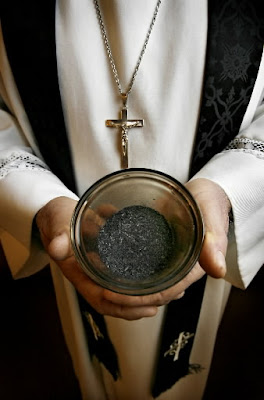
Ash Wednesday introduces the season of repentance -- with prayer, alms-giving, fasting as the traditional pillars.  Every religious tradition I have studied -- and I've not only been researching religions since I was a teenager, but had the opportunity to teach a Religious Studies curriculum for 6 years at a former job, so I've covered quite a few -- every religious community has some way of marking time, of structuring the cycles and patterns of life, something akin to a liturgical year, in which narrative intersects with and is enacted within calendar, where feasts or fasts for some at least are prescribed or proscribed, where space and time, and even silence for self-reflection is opened, where the theme of sin, distance from God and from neighbor, from the persons we ought to be (and study of actual world religions, in their practice, in their scriptures, will tell you that the notion of sin is a lot more widespread than some polemically maintain), becomes a focus.  Sin is multiform and multifaceted, and may be grasped by numerous holds, some of them intellectual, some of them much more affective, some more global, involving universal experiences and conflicts, others so personal that the one holding them within may doubt whether anyone else has ever felt, suffered, done, and regretted what -- or like --  they have.  And all of those complexities and stances, realizations, and progressions and degenerations of moral life are rolled up, implicitly, into the ordering of Ash Wednesday, and Lent, and the Passion, and Easter and . . . .

I pray the Liturgy of the Hours (these days using iBreviary) -- at some times of my life diligently, at others desultorily -- or better put, since I hardly feel as if I'm praying them, I read them, I speak them, or I sing them.  This is another one of those complex intersections of text, ritual, daily practice, tradition of whose depths and fertility some Evangelicals, among others, are becoming aware and enamored.  The Liturgy consists in arranged prayers, many of them Psalms, read at given points in the day. There is a cycle to it, where canticles and verses, Scripture readings and commentaries (in the Office of Readings) bob and weave, dance and chant their ways in and out of the weeks and months.  The Liturgy of the Hours is a complex pattern woven largely out of Scripture, and if one desires or aims to know Scripture better, particularly the Psalms, it is highly recommendable.

Mar 6, 2011

Saint Anselm on Anger (part 3)

The last two Sundays, I posted installments of serialized set of posts, part 1 and part 2 of a longer study of how anger fits into Saint Anselm's moral theory.  That study in its turn forms part of a broader-scope, ongoing set of examinations of anger (and connected topics) as understood by philosophers, theologians, psychologists, and (perhaps later) literary figures, ultimately intended to be housed in books (one of which, dealing with Aristotle on anger, I'm working on currently). Here, in this format, I work out and provide for interested readership the shorter, more preliminary studies of anger that later find their way into more systematic, academic manuscripts.

The last post on Anselm identified four Anselmian virtues bearing on anger:  patience, meekness, humility, and justice, and noted that each of these virtues was a particular habitual and dispositional structure of the human will, instantiated not only in the uses the human person chooses to make of his or her will, but even more so in  lasting affective currents of desire, fateful shaping, character, what Anselm calls will as affectio.

In order to better understand virtues, and their opposite, vices, we have to understand the will, and that requires us to understand a number of other interrelated matters.  There are good reasons why we human beings are so often mysteries to ourselves even when we think we best understand and know ourselves, and Anselm touches on this while mimetically representing what must have been a common enough occurrence in his life and teaching, begging off from giving his views and rational reflections on a divine mystery in Cur Deus Homo:
we need an analysis of ability and necessity and will and of other notions which are so interrelated that no one of them can be fully examined apart from the others. . . . For an ignorance of these notions produces certain difficulties which become easy to deal with as a result of understanding these notions.