Showing posts with label christian philosophy. Show all posts

Oct 20, 2019

Six Videos on Augustine of Hippo's On Free Choice of the Will, book 1


I've been teaching Augustine's On Free Choice of the Will in my Introduction to Philosophy and Foundations of Philosophy classes for a number of years.  In the past, I have had students read the entire work, but given how many other texts I usually pack into a semester, I've trimmed down our study to just book 1 of the work.

Creating video content - as busy as I am - is a continual process, and I'm not always able to shoot video on all of the texts I teach in face-to-face classes.  I was able to produce core concept videos on portions of a different work by Augustine in the past - his City of God - but I didn't manage to get to On Free Choice of the Will until this term.

Now, I have six videos on key topics in book 1 of that work available for not only my students, but also for the general public.  Here they are:

Jun 10, 2016

Free Video Resources on St. Anselm's Monologion

Off and on, from March to May, I created a new series of Core Concept videos devoted to a classic text of Medieval Christian philosophy, Saint Anselm's early work, the Monologion.

This book is in, in fact, Anselm's earliest treatise, written when he was prior of the monastery at Bec, after numerous requests by his fellow monks that he write down some of the arguments, reflections, and explanations about the divine substance that he was providing them with in his teaching and conversations.

I shot and uploaded this sequence of videos, covering most of the chapters and topics in the Monologion.  For whoever would like to watch and use them, here they are - all 24 of them.


I'll be producing further videos on Anselm later on this Fall, starting with his next main work, the Proslogion. If you're interested in further study of Anselm's texts with me specifically, I will be teaching an online course on Anselm later on this Fall, and I'm always available for tutorial sessions. 

Oct 13, 2015

Two Working Papers from the ACPA Conference

When I'm able to, I typically attend the American Catholic Philosophical Association, one of the larger and more important annual philosophy conferences in the United States.  As a graduate student and young professor, I started out giving papers in the main ACPA sessions (including these on Hegel, Blondel, Anselm, and Aristotle). In more recent (and busier) years, I've tended to miss the traditional April deadline for submitting papers.  But, I've also been asked to contribute papers for what are called "satellite sessions" -- which are, by the way, one of my favorite features of the ACPA conference.

This year, I was approached by several different organizations to give a paper at their satellite sessions, and I actually had to turn some down -- two is effectively the maximum for me.  The Gabriel Marcel Society and the International Etienne Gilson Society assembled their panels the quickest, so I committed to speaking during their sessions.

Sep 8, 2015

Theology Matters Guest Appearance: The 1930s Christian Philosophy Debates

Taking up the standing invitation to come back on the weekly Theology Matters with the Pellews internet radio show, I made a guest appearance last week.  This time the topics under discussion between myself, the host, and callers were several of the main issues and ideas of my 2011 book, Reason Fulfilled by Revelation:  The Christian Philosophy Debates in France (published by Catholic University of America Press).

The notion, the problem, and the historical examples of Christian philosophy -- and those 1930s debates in particular -- are topics that I've greatly enjoyed researching, writing on, and talking about over the last decade.  So, I was quite happy to come back on the show specifically to discuss them.

For those who would like to listen to the audio of the show, minus the first portion (which featured a different guest) and the advertisements, I've put it into a podcast mp3 form, which you can download or listen to.

Aug 23, 2013

Second Radio Interview: Thomas Aquinas and Natural Law

Invited back to Theology Matters with the Pellews -- the idea being that I might start doing more or less regular guest spots focused on key Christian (and also atheist) thinkers of the past -- I proposed that my discussion this time focus on Thomas Aquinas and his conception of Natural Law.  Not just Natural Law by itself, in isolation, though, but understood in conjunction with several other key conceptions of laws in Thomas' thought, namely, Eternal Law, Divine Law, and Human Law.

The original date had to be shifted from early August to later on in the month, due to some computer issues on the end of the show, which prefigured a few technical difficulties that occurred during the second portion of the actual show.  Overall though, it seems -- going by listener responses -- to have been a good show.  Given my somewhat perfectionist tendencies, the fact that I was one of the speakers, and the sort of "professional blinders" that being an expert in the field inevitably brings, I'm not a good judge of these sorts of matters -- how well the presentation, the dialogue, the interaction actually illuminated Thomas thought for the non-philosopher listening in.

If you'd like to listen to -- or download -- the full podcast of the show, you can do so by clicking here.

Jul 19, 2013

Talk Radio Interview: Saint Anselm's Argument

Last night, I appeared as a guest on an internet radio talk show -- Theology Matters with the Pellews.  Devin Pellew turned out to be an engaging host, quite interested in the topic I had proposed to focus upon:  the "single argument" Saint Anselm elaborates in his early work, the Proslogion.

The first hour or so of the show was simply Devin and I, doing some back-and-forth discussion, starting with the more general, and then zeroing in on several key themes having to do with Anselm -- I'll say what those were shortly.  Then, we had the call-in segment, and I participated in some very enjoyable conversations with several different callers.

If you'd like to hear the show -- or to download the mp3 of it -- you can access it here.  For me, it was an opportunity to explore, in a different medium, some themes I've been thinking about for a long time, and to communicate my own interest in these themes to a broader, less academic audience -- the sorts of people actually, that Anselm himself spent much of his time working with, counseling, and even teaching.

So, what did we range over?  A number of topics that I think would make good starting points for future blog posts.  To start with, Anselm's "argument" turns out not to be the "ontological argument" (a name he wouldn't recognize, since it appears only from the time of Kant onward), but rather a much broader, deeper, yet more interesting structure that runs through nearly the whole of the Proslogion. This shouldn't be surprising, really, if we look at what Anselm himself tells us the argument is suppose to attempt and attain -- or if we actually read the Monologion, for whose multiple arguments this "single argument" is supposed to substitute.

We also talked about Anselm's own purposes in providing this argument in a written form -- he's not doing Christian apologetics as we often conceive of it, not trying to produce arguments to convince the unbelievers primarily.  Rather, he tells us that he felt joy in discovering and exploring the argument, and wanted to share that experience -- or at least its apparatus -- with others.  Interestingly, this wasn't how he felt about it at the start or in the middle of his enquiry.  Another key theme, which I'll doubtless blog about later this Fall, is how Anselm could think, for a while. . .  that the argument might actually be a trick of the Devil. 

May 29, 2012

Happy Birthday G.K. Chesterton

birthday chesterton father brown orthodoxy philosophy theology christian faith madness
Today is the birthday of one of my favorite philosophers -- indeed, in my book a writer legitimately termed a philosopher, though many would rather recall him as a novelist, a cultural critic, an essayist, perhaps even in a sense a theologian -- Gilbert Keith Chesterton.  If I had to adduce only one reason for calling him that, I might cite his own words from the first page of his own Orthodoxy, where he tells us:

I have attempted in a vague and personal way, in a set of mental pictures rather than in a series of deductions, to state the philosophy in which I have come to believe.  I will not call it my philosophy; for I did not make it.  God and humanity made it; and it made me.
Now, as one of the so down-to-earth-characters into whose mouth that author inserted so many excellent quips, paradoxical assertions, and deductions, might have said, we ought not allow ourselves to be followed into concluding that someone is actually a philosopher, simply on the say-so of their speaking of having a philosophy, even of believing in one -- or still yet attributing it to others and claiming to have been shaped and reformed by it.  After all, people are prone to say all sorts of things about themselves, true, false, sage, foolish, deceptive, furtive, bold, craven -- even sometimes to reveal to the attuned eye or the attentive ear realities they only dimly know themselves. 

May 5, 2012

Happy Birthday, Søren Kierkegaard

soren kierkegaard birthday main works: fear and trembling sickness unto death philosophical fragments present age key themes: faith reason philosophy god publicity public opinion paradox christian religion
More than half of my life now, Søren Kierkegaard has occupied a top seat in the shifting chorus of my favorite philosophers -- something one would hardly guess by looking at my scholarship, which has focused much more upon other thinkers: Aristotle, St. Anselm, Thomas Aquinas,Thomas Hobbes, G.W.F. Hegel, Maurice Blondel, Alasdair MacIntyre, each of which I've found sufficiently fascinating to be drawn into reading and rereading, taking notes upon then writing, and when lucky, publishing articles about, each one of them a great philosopher in his own right, worth studying, engaging in intellectual dialogue and musing reflection full-time the rest of my remaining lifetime.

Yet, given the choice at any given moment about whose book to pull off the shelf, crack the pages open, and begin reading anew, I find it tempting not to select Kierkegaard, particularly these days his Philosophical Fragments, The Concept of Irony, and The Sickness Unto Death. That attraction has altered over time, not so much changed in the sense of transmuting entirely from one thing, away from that and towards yet another, different thing in its place.  Rather, I'd say, as with a wine, or port, or liquor whose aging permits flavors, scents, textures, already there to be sure but only in potency, to unknot their bonds, to freely mingle and wax into a more complex, symphonic taste -- that's what happened with my appreciation of Kierkegaard, though along these lines of analogy, it would be better to say that my palate gradually took on the sharpness to distinguish and more deeply enjoy drinking in the flights of draughts he assembles and then offers.

Nov 21, 2011

Self-Promotion: How Much is Too Much? (part 1 of 3)

self promotion lesboprof chronicle higher education truth falsity lie bragging disclosure virtue vice ethics moral colleagues academics virtuous vicious
A thought-provoking piece by the equally provocatively self-titled Lesboprof in the Chronicle of Higher Education today raised but did not resolve a question, one particularly intended for academics -- but by extension, others as well --to what degree ought one engage in self-promotion?  How much -- and how precisely -- ought one to bring to or even impress upon the attention of others one's own accomplishments, successes, projects, qualities?  She doesn't provide a hard-and-fast answer, writing that:
I discussed with my friends the issue of what counts as shameless self-promotion and what is wanting to share excitement and pride in one’s accomplishments. It is difficult to clearly delineate between the two.
 As I reflected upon the matter -- well supplied for rumination on this by experience of more than a decade in the academic racket, during which I've seen many cases that crossed the line into blatant, tasteless self-promotion, as well as many other people's achievements or contributions go unrecognized, held similar conversations about how to decide and determine cases and rules for this, and even had to gradually work out my own position and practice -- it struck me not only that this would in fact be precisely the kind of topic to which Virtue Ethics could bring some needed clarity and guidance, but that in point of fact, some of the classic proponents and developers of that moral approach in fact had written relevant passages bearing on the matter.

Sep 4, 2011

Virtuous Humility . . . and Pride?

A month or so back, attending the ISME conference, I came across an interesting paper delivered by Kristen McPherson, a Marquette doctoral candidate with a promising project bearing on the topic of humility and pride. The natures and values -- positive or negative -- of these opposed affective states is a subject upon which many different, some mutually incompatible, viewpoints have been worked out down the centuries, and a pattern and (broadly speaking) point of progress is what I aim to write about here – a way of returning to the theme of my earlier Sunday posts prior to the blogging hiatus imposed by my summer travels: theological, specifically monastic treatments of humility as a virtue.
 
What particularly caught my attention in that ISME paper were three things: a goal, a claim, and an omission. One of the stated goals was to provide a naturalized account of pride and humility, one which would presumably draw upon the centuries of hard-earned insights and progressively developed intellectual resources of Christian thought on pride and humility but in such a way as to strip away the specifically Christian elements, arguments, appeals, concepts, so as to leave a residue or precipitate equally acceptable (even embracable, incorporable) to secularists of good faith as to committed Christians. The interesting, and to me startling claim was that we ought not only to think in terms of vicious pride, a vicious counterfeit to humility, and genuine and virtuous humility, but also in terms of virtuous pride as well.

The omission was that. . . . well as it turns out, what counted as stand-ins for the wide scope of Christian thought was . . . you guessed it: Augustine and the later, greater Thomas Aquinas. Now, I would be far from faulting diligent study of, and reliance upon, the thought of these two great Doctors, but when it comes to the matter of humility and the distinctively Christian understanding, it can only help one to read monastic as well as scholastic writers – Thomas, for one drew deeply on the wellsprings of wisdom afforded him by generations of monastic authors.

Aug 21, 2011

Catching Up With Anselm the Christian Philosopher

I'm still in the midst of writing another Anselm-themed post which will appear later this week (or next week), dealing with justice, mercy, and our (often inadequate) images of the divine -- but I found myself, instead of reading through those texts most germane to such purposes and topics, following once again down the paths, seemingly so straightforward and sunlit, but occasionally and admittedly to me obscure, of the beginning five chapters of Anselm's first treatise, the Monologion.  This text, in our times relatively little known and studied (except by Anselm scholars, philosophers of religion, or historians of medieval thought), is both programmatically and exemplarily emblematic of the Anselmian project of fides quaerens intellectum, "faith seeking understanding" -- although some better Anselm scholars than myself have argued that an equally important and characteristic contribution by Anselm is his well-worked-out conception of justice as rectitudo voluntatis propter se servata, "rectitude of will kept for its own sake".

Rereading and ruminating upon these chapters, mulling through them, actively dialoging with their assertions and arguments -- using them as they were designed, by Anselm's own lights -- got me thinking both about Anselm's moral theory (the broad and multifarious topic about which I'm currently -- with painful, though perhaps not painstaking, slowness -- researching and writing a book) and about the "problem" of Christian philosophy (as it is often put, concealing a tangled an wideranging number of problems, issues, historical phenomena, debates. . . ).  I noticed a confluence of these two sets of concerns.

Apr 28, 2011

Kicking off my Book Tour in National Library Week

notre dame hesburgh library christian philosophy debates 1930s blondel gilson maritain religion faith reason
Nearly a week and a half of busily packed days have passed since I officially started the tour for my book Reason Fulfilled by Revelation: The 1930s Christian Philosophy Debates in France  at our own Charles Chesnutt Library at Fayetteville State University.  I didn't realize until I started putting my presentation together precisely how appropriate an occasion and location that was.  The story that I'm going to tell, reflect upon, draw some implications from, and conclude with an argument about resources and policies - - the story of my research and the book that eventually emerged from is also the story of a library, the University of Notre Dame Hesburgh Library, a library of a certain type that unfortunately seems to be at risk for gradually dwindling away, faced with the twin pressures of a digital age and the costs of maintaining library stacks.

I'm not going to talk much about my book in this entry, other than to say that I'll be adding a video (to My New Book) discussing how it is intended to make contributions to scholarship in several respects somewhat different than and complementary the volumes of secondary literature -- or even original groundbreaking work in Philosophy, Religion, History, Political Theory, or Rhetoric -- the disciplinary circles in which I move and appreciate the works of my peers.  What I will note first about Reason Fulfilled By Revelation is that were it not for the existence nearby of a certain kind of library, a certain form of repository of human knowledge, of intellectual striving and dialogue, the research that I carried out would have been. . . . well, not entirely inconceivable, but practically speaking rendered impossible

Apr 9, 2011

Plato, Persons, and the Ascent to the Highest Good

My colleague Eric Silverman hosted me in his Plato class at Christopher Newport University this last Wednesday, where I delivered a guest lecture (video available here)-- with much contribution from his student's questions, objections, puzzles, and discussion -- ostensibly focused on Diotima's speech (in Socrates' speech) nested in the very heart of Plato's dialogue, the Symposium -- but actually taking the opportunity to work out and talk about a few parts of one of my own projects concerned with Plato.

plato symposium highest good form god ascent love desire personality person
That dialogue is, and will ever remain, a central work in the history and discipline of philosophy.  It has inspired commentators, appropriators, perhaps even what might be called imitators down throughout the ages.  Its depiction of philosophy, indeed of many types of activity and inquiry, as fundamentally erotic will ever seduce new students to read it through and then return to explore its fascinating passages, and will draw back old friends and lovers, professors whose copies of it bear wear as signs of diligent study -- or even as the guide with whom I first traversed the dialogue in Greek with called it, an inability to put the book away because every time one opens it, in turn it opens in the reader's mind new, gnawing, aching questions.

Mar 11, 2011

Reflections on Repentance, Psalms, and Philosophy

Wednesday was one particularly important days of the liturgical year, involving a ritual often viewed as distinctively or exclusively "Catholic," often to the dismay of Protestants belonging to denominations which retained enough from the Catholic church for their more radical Protestant brethren to criticize them as remaining still far too "popeish" -- Lutherans, Anglicans (including Episcopalians), Methodists (who after all were at one time Anglicans themselves). . .  really anyone who recognizes some sense or value to a liturgical year might find themselves marked by an ashy cross smudged on their forehead.  This includes those Evangelicals who, regretting losses which occurred through ever more radical waves of Reformation, are now finding value in cautiously reappropriating rituals, notions, actions, lines of thought, ways of life formerly considered far too Romish.  My partner texted to tell me how startled she was at the sight of a drive-through where one could be marked with the sign of repentance. For me, that is Evangelicals doing things as they tend to do them best, enthusiastically, exploiting aspects we Christians less experimental and settled in our ways of doing things would never think of,  sometimes introducing a bit of unintentional comedy.
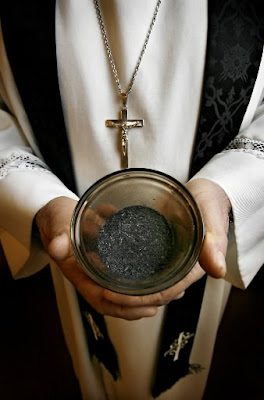
Ash Wednesday introduces the season of repentance -- with prayer, alms-giving, fasting as the traditional pillars.  Every religious tradition I have studied -- and I've not only been researching religions since I was a teenager, but had the opportunity to teach a Religious Studies curriculum for 6 years at a former job, so I've covered quite a few -- every religious community has some way of marking time, of structuring the cycles and patterns of life, something akin to a liturgical year, in which narrative intersects with and is enacted within calendar, where feasts or fasts for some at least are prescribed or proscribed, where space and time, and even silence for self-reflection is opened, where the theme of sin, distance from God and from neighbor, from the persons we ought to be (and study of actual world religions, in their practice, in their scriptures, will tell you that the notion of sin is a lot more widespread than some polemically maintain), becomes a focus.  Sin is multiform and multifaceted, and may be grasped by numerous holds, some of them intellectual, some of them much more affective, some more global, involving universal experiences and conflicts, others so personal that the one holding them within may doubt whether anyone else has ever felt, suffered, done, and regretted what -- or like --  they have.  And all of those complexities and stances, realizations, and progressions and degenerations of moral life are rolled up, implicitly, into the ordering of Ash Wednesday, and Lent, and the Passion, and Easter and . . . .

I pray the Liturgy of the Hours (these days using iBreviary) -- at some times of my life diligently, at others desultorily -- or better put, since I hardly feel as if I'm praying them, I read them, I speak them, or I sing them.  This is another one of those complex intersections of text, ritual, daily practice, tradition of whose depths and fertility some Evangelicals, among others, are becoming aware and enamored.  The Liturgy consists in arranged prayers, many of them Psalms, read at given points in the day. There is a cycle to it, where canticles and verses, Scripture readings and commentaries (in the Office of Readings) bob and weave, dance and chant their ways in and out of the weeks and months.  The Liturgy of the Hours is a complex pattern woven largely out of Scripture, and if one desires or aims to know Scripture better, particularly the Psalms, it is highly recommendable.

Mar 6, 2011

Saint Anselm on Anger (part 3)

The last two Sundays, I posted installments of serialized set of posts, part 1 and part 2 of a longer study of how anger fits into Saint Anselm's moral theory.  That study in its turn forms part of a broader-scope, ongoing set of examinations of anger (and connected topics) as understood by philosophers, theologians, psychologists, and (perhaps later) literary figures, ultimately intended to be housed in books (one of which, dealing with Aristotle on anger, I'm working on currently). Here, in this format, I work out and provide for interested readership the shorter, more preliminary studies of anger that later find their way into more systematic, academic manuscripts.

The last post on Anselm identified four Anselmian virtues bearing on anger:  patience, meekness, humility, and justice, and noted that each of these virtues was a particular habitual and dispositional structure of the human will, instantiated not only in the uses the human person chooses to make of his or her will, but even more so in  lasting affective currents of desire, fateful shaping, character, what Anselm calls will as affectio.

In order to better understand virtues, and their opposite, vices, we have to understand the will, and that requires us to understand a number of other interrelated matters.  There are good reasons why we human beings are so often mysteries to ourselves even when we think we best understand and know ourselves, and Anselm touches on this while mimetically representing what must have been a common enough occurrence in his life and teaching, begging off from giving his views and rational reflections on a divine mystery in Cur Deus Homo:
we need an analysis of ability and necessity and will and of other notions which are so interrelated that no one of them can be fully examined apart from the others. . . . For an ignorance of these notions produces certain difficulties which become easy to deal with as a result of understanding these notions.

Feb 12, 2011

John Cassian on Anger, Revisited

john cassian monk monastic anger desert institutes conferences god religion spirituality virtue vice
In a previous blog post, discussing the great monastic author John Cassian's very interesting views on anger (and by the way, recently saw an excellent piece on John Cassian and Church Tradition), I ended by setting out a paradox
If a person is entirely responsible for their own anger, if seeing things rightly and making progress depends on grasping this very truth that one cannot displace the blame for one's anger onto another, onto the towards whom one feels angry -- doesn't that go for me too?  Why isn't my neighbor also entirely responsible for his own anger?  Does not his or her responsibility absolve me then of mine?  Going further, if there is some responsibility still on my side, well then, what of God, if He made me angry -- or certainly made people angry with Him as recorded in Scripture?  Would not that line of reasoning make God also responsible?
As typically the case with  paradoxes, more resides beneath the surface than appears at first glance.  One can twist this plaint in two different directions: a horizontal one,  remaining on the same, human level; and, a vertical one, looking upwards, bringing God in for argument.  This latter, one should point out, can go two ways as well: one might point to Scripture's instances and examples of divine anger, and ask:  look, if it's all right for God to be angry -- and He's God after all -- why not me?  Alternately, one might also find fault with the way God has managed matters, the providential ordering by which He arranges the world, one so complex, flexible, and yet inescapable that even human free will is able to be incorporated within it.

Dec 7, 2010

What's Lost in Translation, and What's Not (part 2)

As if I were addressing a room, rather than casting my bread upon the waters of cyberspace, I'll start with an anecdote, one which I find funny.  Hopefully you will also see the somewhat dark humor in it.

Several years back, Alasdair MacIntyre was on some panel at the Modernity:  Yearing for the Infinite conference at Notre Dame.  I entirely forget what the discussion was about, but remember well a remark he interjected, or at least its essential content.  So, in Thucydidian reformulation (having the characters in one's narrative say not what they really said but what they ought to have said, given their ethos) :
When I was a boy, we were beaten if we did not learn Greek irregular verbs well.  I am not defending beating children.  In fact that is a very bad thing to do, both for the children and for those beating them.  It was painful, and produced anxiety.  But now . . . I can read Sophocles and you can't.
A fellow philosopher Dave O'Hara and I started a conversation on Twitter about languages and translations in philosophy, one which I am certain just as much on his side as on mine, reverberates with countless conversations he carried out with other people down the years. When students in class, other professors, parishioners in study groups, fellow travelers passing the time with talk, and the host of other seemingly chance interlocutors find out that you can read a text in its original language, a language they do not know, there are some standard lines in which the discussion typically develops.  Guiding, understandable, but mistaken assumptions come to light.  Sometimes I point them out.  nowadays, I usually just pass over them and allow the conversation to go as the other person seemingly needs it to proceed.

Dec 5, 2010

Wisdom Literature and Philosophy

Already indulging in one digression from the discussion about the value of translations and original languages in studying philosophy -- since I really ought to follow up with a post setting out my probably eccentric views on which criteria can be given, explained, and defended for what constitutes a good translation -- I'm going to take a different tack and blog about a topic which more than tangentially coincides with a long-time obsession of mine, the complicated question of Christian philosophy.  And, since I like to break up my perhaps overly long and dense entries from time to time with an image, here's the cover I ended up choosing for my volume coming out soon with Catholic University of America Press.
So, after that shameless plug. . . on with the digression! 

I noted that I was happy engaging an interlocutor who shared a lack of a typically modern assumption, namely that philosophy was in some way strictly separated from theology or religion.  This was not an assumption commonly made in antiquity, nor in the medieval period (at least until the fields of philosophy and theology not only came to be distinguished from each other but were often separated from and opposed to each other).  For my part, I don't think that this simply represented a confusion or lack of development on the part of those earlier thinkers, as many scholars seem to -- though I am willing to concede that some figures may have blurred these together.

Dec 2, 2010

What's Lost in Translation, and What's Not (part 1)

A philosophical colleague of mine, Dave O'Hara, who I must admit not to knowing well, has been carrying on an interesting exchange with me about languages, translations, and philosophy.  So far, we've been conversing about it via the bite-size  passages the microblog Twitter permits (though Dave used the "part 1. . .  part 3" multiple post way around the length limit).  I found myself, as I often do with Twitter, somewhat frustrated at having to reduce complex thoughts on tricky matters to easily misinterpreted sound bites (though I must admit, I also do enjoy the challenge), and the issues raised are genuinely deep philosophical ones, so I decided those issues deserved a blog entry.

Here's how the exchange developed:

(Dave O'Hara)
Philo tweeps: how important do you consider learning languages for the study of philosophy? Which languages?
Langs? Absolutely important! For Western: Greek, Latin, French, German. Ex: Aristotle, key concepts across texts lost in translation

Oct 24, 2010

Why It's Been Quiet

A short post, just to wiggle my toe in the blogging waters (actually have a few posts currently parked and waiting the time and energy to be finished).  In addition to CLA matters aplenty, committee work, teaching classes, and readying presentations, this month has been given over to finishing one stage of what has been so far a 6 year project, and starting another stage.

About six years ago, two years into teaching Philosophy and Religious Studies classes at Indiana State Prison, just two years out of grad school, Adrian Papst, a young, earnest English Catholic guy who was studying at the Institut Catholique de Paris (and whom I'd met at the stimulating Continental Philosophy of Religion conference in Lancaster, where the Radical Orthodoxy types squared off against the Pomos / Derridians), sent me a packet of photocopied documents.

He knew of my love for Maurice Blondel's thought and (largely still untranslated) works, and he mailed me several accounts of meetings of the Société Française de Philosophie, in which Blondel had been involved, accompanied by some other Blondel documents from the early 1930s.  These turned out to be key writings of Blondel during the 1930s Christian Philosophy Debates, which ran roughly from 1931-35 or 36 (depending on how you want to draw the historical boundaries), but I did not know it at the time, until I started reading through the pieces he had sent, and following up with some research and photocopying of my own.